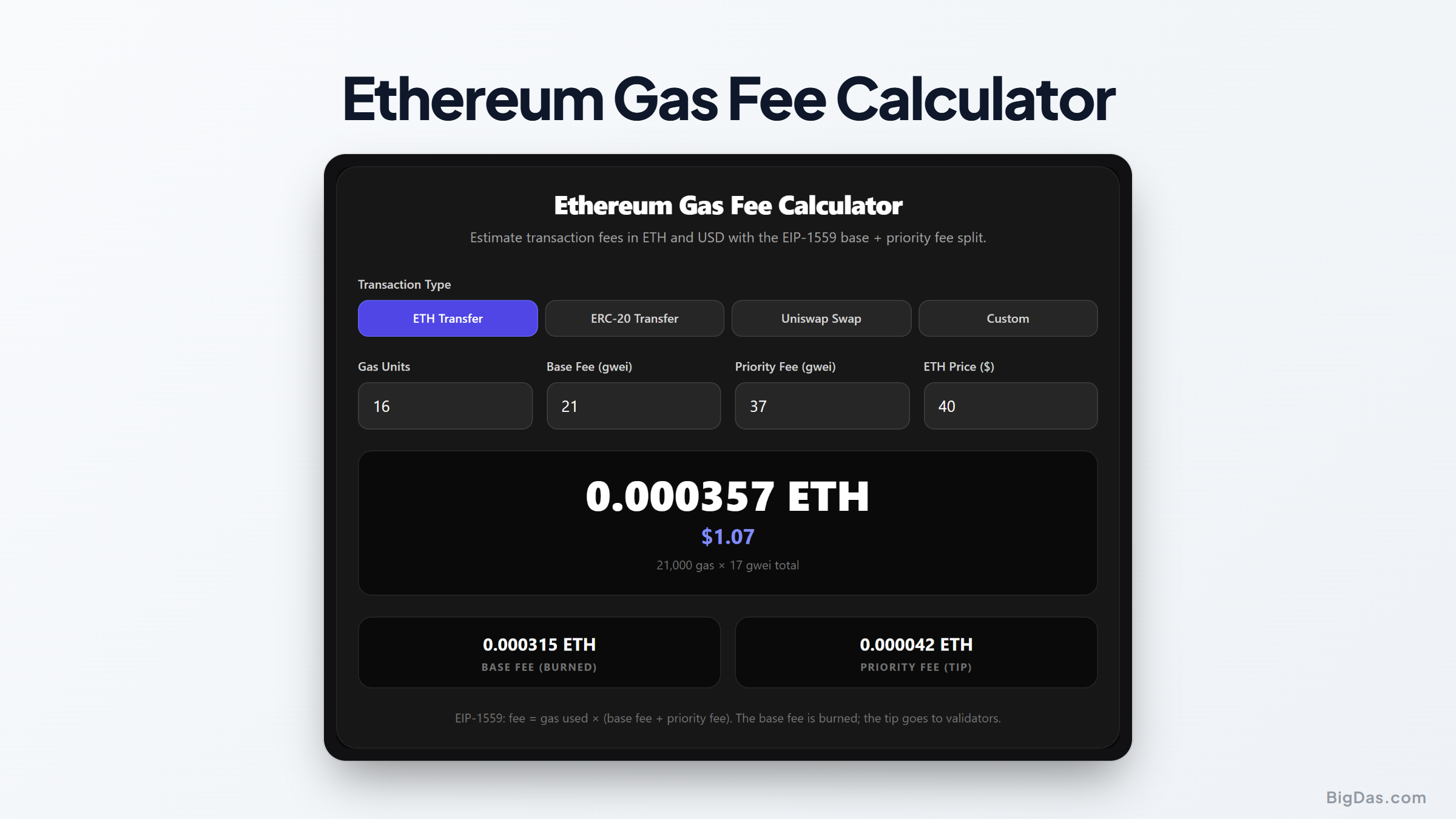
Ethereum Gas Fee Calculator
 Generated infographic and interface snapshot for Ethereum Gas Fee Calculator
Ethereum Gas Fee Calculator: Calculate ETH Transaction Costs and Gwei Rates
Transacting on the Ethereum blockchain requires paying network fees, commonly known as gas. Because Ethereum processes thousands of transactions every minute, network demand fluctuates constantly. Gas prices rise and drop sharply within short periods. For anyone sending Ether, trading tokens on decentralized exchanges, or interacting with smart contracts, knowing the cost of a transaction before submitting it is essential. Without precise calculations, you risk overpaying for basic transfers or submitting transactions with fees that are too low. Underpriced transactions can stall in the memory pool for hours or fail entirely, burning gas without completing the intended action. An ethereum gas calculator translates blockchain parameters into clear calculations in ETH and USD. This guide covers how gas works on Ethereum, how to convert Gwei to ETH, how EIP 1559 fee mechanics work, and how to use a gas fee calculator to manage your transaction costs.
What is an Ethereum Gas Fee Calculator?
An ethereum gas calculator estimates the cost of executing smart contracts or transfers on the Ethereum mainnet. Gas is the unit of measurement for computational effort required to process operations. Simple actions require few gas units, while interactive smart contracts require significantly more. To understand how a gas fee calculator works, it helps to understand the main components involved in calculating an eth transaction cost:
1. Gas Limit (Gas Units)
Every transaction type on Ethereum requires a minimum amount of work measured in gas units:
- Standard ETH Transfer: 21,000 gas units.
- ERC 20 Token Transfer: roughly 65,000 gas units on average.
- Uniswap Token Swap: between 150,000 and 200,000 gas units depending on liquidity pool routing.
2. Gas Price and Gwei
Gas prices are quoted in Gwei, a subdenomination of Ether. One Gwei equals one billionth of an ETH (0.000000001 ETH). Expressing fees in Gwei makes smaller fractional amounts easier to read than long decimal figures.
3. EIP 1559 Fee Architecture
EIP 1559 splits fees into two parts:
- Base Fee: The baseline cost required to include a transaction in the next block. The network sets this automatically based on block space demand. This fee is burned permanently.
- Priority Fee (Validator Tip): An additional fee paid directly to network validators to prioritize your transaction during periods of heavy congestion.
An EIP 1559 fee calculator adds the active base fee to your designated priority fee, multiplies that total by the gas limit for your specific action, and provides an instant calculation in both ETH and USD.
Key Features and Benefits
- Preset Transaction Types: Switch between standard ETH transfers, ERC 20 token movements, and Uniswap swaps without manually searching for gas limits.
- Instant Gwei to ETH Conversion: Converts Gwei figures directly into ETH values and USD estimates based on current market rates.
- EIP 1559 Parameter Support: Separates base fees from priority tips, letting you customize your priority settings based on confirmation speed.
- Prevention of Failed Transactions: Helps you set an adequate max fee, reducing the chance of running out of gas mid execution.
- Expense Planning: Allows you to time your interactions, waiting for low congestion windows to process high gas operations like contract deployments or liquidity provisioning.
Step by Step Guide to Calculating Gas Fees
Step 1: Select Your Action Preset
Choose the transaction type you plan to execute:
- ETH Transfer for sending raw Ether to another address.
- ERC 20 Transfer for moving tokens such as USDC, USDT, or LINK.
- Uniswap Swap for executing a trade on a decentralized exchange.
Selecting a preset populates the required gas limit field with the appropriate baseline value.
Step 2: Check Current Network Base Fees
Look at the live base fee provided by the tool. If network demand is low, base fees might range between 5 Gwei and 15 Gwei. During high activity periods, base fees can surpass 50 Gwei or 100 Gwei.
Step 3: Set Your Priority Fee (Tip)
- Slow or Standard (1 to 2 Gwei): Ideal for non urgent transfers or regular wallet maintenance.
- Fast (3 to 5+ Gwei): Recommended during token launches or high volume trading periods to ensure quick inclusion in the next available block.
Step 4: Review the Estimated Costs
The tool processes your inputs using the standard formula:
$\text{Total Fee in ETH} = \text{Gas Limit} \times (\text{Base Fee} + \text{Priority Fee}) \times 10^{-9}$
The output presents the total transaction cost in ETH alongside the current value in USD, allowing you to decide whether to proceed immediately or wait for lower network traffic.
Common Use Cases for a Gas Calculator
Trading on Decentralized Exchanges (DeFi)
Automated market makers like Uniswap interact with multiple smart contracts per swap. If gas prices spike while your trade is pending, you might pay tens of dollars in transaction costs for a low value trade. A gas fee calculator helps you weigh prospective slippage and network costs against trade profits.
Managing ERC 20 Token Portfolios
Moving small balances of ERC 20 tokens can sometimes cost more in gas than the value of the tokens themselves. Checking transaction costs beforehand helps you decide whether consolidating balances or transferring tokens across Layer 1 is financially sensible.
NFT Minting and Transfers
Non fungible token mints often create temporary surges in network activity. Gas calculators let collectors set appropriate priority fees to secure their mints without overpaying.
Web3 Application Development
Developers building decentralized applications use gas calculators to estimate execution costs for smart contract methods, helping them write more gas efficient code before deploying to mainnet.
Frequently Asked Questions
What is Gwei and how do I convert Gwei to ETH?
Gwei is a denomination of Ether used to measure gas prices. One Gwei represents $10^{-9}$ ETH, or 0.000000001 ETH. To convert Gwei to ETH manually, multiply the total Gwei by 0.000000001. A gas calculator performs this conversion automatically in real time.
Why do Uniswap transactions cost more than ETH transfers?
A simple ETH transfer only updates balance records on the blockchain ledger, which takes 21,000 gas units. A Uniswap swap runs smart contract logic, checks token reserves, calculates liquidity paths, updates multiple balances, and executes internal routines. This extra computational work requires between 150,000 and 200,000 gas units.
How does EIP 1559 prevent overpaying for gas?
Before EIP 1559, Ethereum used a blind auction model where users guessed how much to bid for block space, often leading to massive overpayments. EIP 1559 sets an algorithmic base fee for the entire network based on previous block density, so users only need to add a small priority tip to secure fast processing.
What happens if my transaction runs out of gas?
If you set your gas limit lower than the actual amount required by the smart contract, the transaction will fail. The network reverts all state changes, but the gas consumed up to the failure point is retained by validators to cover the computational work performed. Using preset gas estimates helps avoid out of gas errors.
Managing Ethereum Transaction Costs
Ethereum transaction fees come down to timing and clear visibility into network mechanics. By understanding gas limits, Gwei conversions, and base fee behavior under EIP 1559, you can interact with decentralized applications more efficiently. A gas calculator eliminates guesswork, letting you estimate transaction costs accurately, choose priority tips, and plan your Web3 activities.