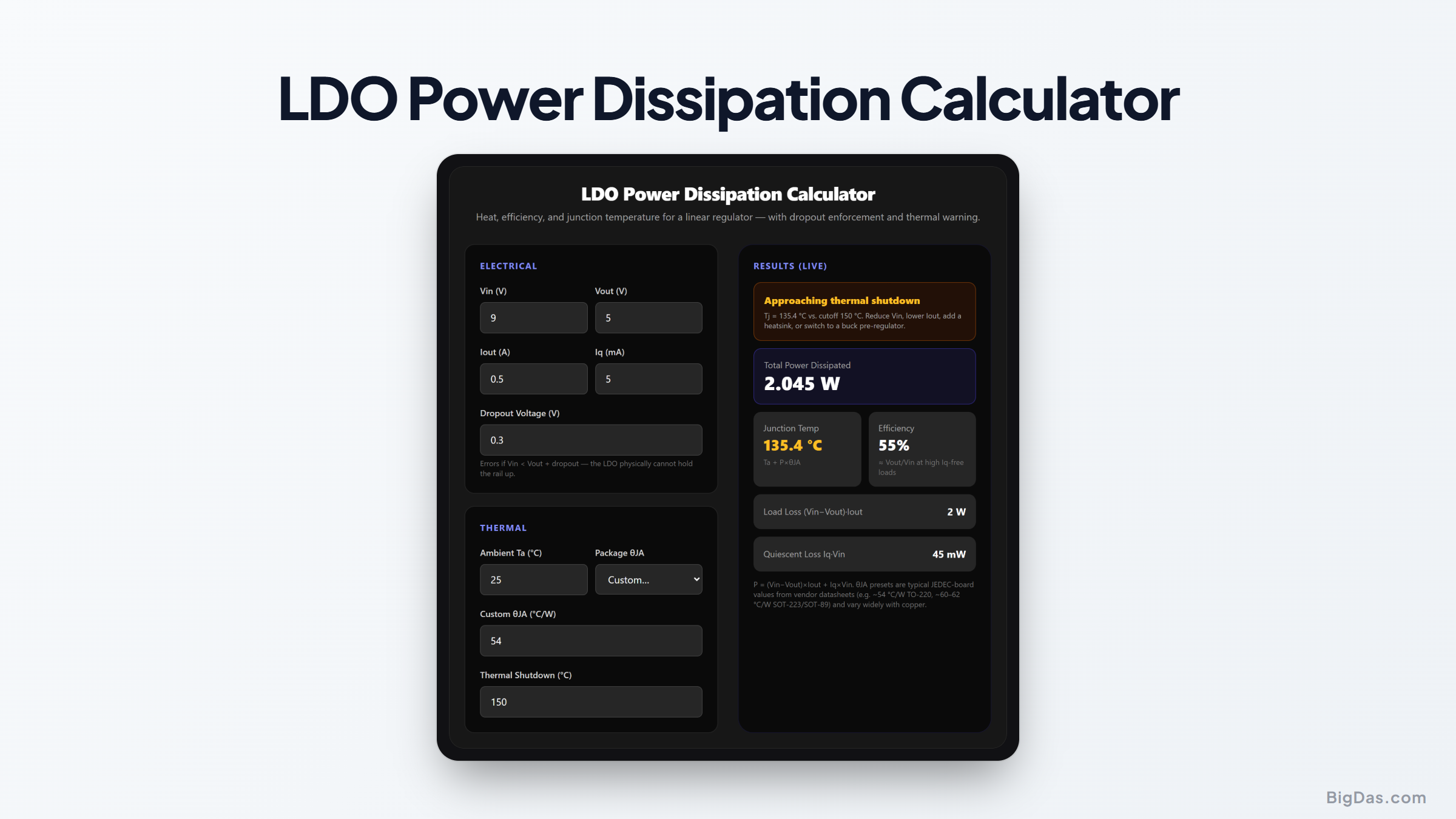
LDO Power Dissipation Calculator
 Generated infographic and interface snapshot for LDO Power Dissipation Calculator
Find out whether your linear regulator will cook before you power it up.
Free LDO Power Dissipation Calculator Online. Big Das
Linear regulators are quiet, cheap, and simple, but every wasted volt turns straight into heat. The Big Das LDO Power Dissipation Calculator computes regulator loss, efficiency, and junction temperature from θJA presets (SOT-223, SOT-89, TO-220), flags thermal shutdown risk, and errors out when Vin is below the dropout headroom.
What Is LDO Power Dissipation?
A low-dropout regulator (LDO) keeps a clean output by burning the difference between input and output voltage across its pass transistor. That energy has to go somewhere: into the silicon, and from there into the ambient air.
Two contributions matter:
- Load dissipation: (Vin − Vout) × Iout, the dominant term. Dropping 9 V to 5 V at 500 mA wastes 2 W.
- Quiescent dissipation: Iq × Vin. The regulator's own housekeeping current, usually small, but not zero at high Vin.
How to Use the Calculator
- Enter Vin and Vout.
- If Vin is below Vout + dropout, the tool errors, an LDO cannot regulate upside-down.
- Enter the load current.
- Iout in amps.
- Enter the dropout voltage from the datasheet at your load current (e.g. 0.3 V).
- Enter the quiescent current.
- Iq in mA (also from the datasheet).
- Pick the package preset (SOT-223, SOT-89, TO-220) or enter a custom θJA, and set ambient temperature.
- Check junction temperature: red means thermal shutdown is imminent or tripped.
The Formulas Used
$$ \text{Load dissipation: } P_{load} = (V_{in} - V_{out}) \times I_{out} $$
$$ \text{Quiescent dissipation: } P_{iq} = I_q \times V_{in} $$
$$ \text{Total: } P_{tot} = P_{load} + P_{iq} $$
$$ \text{Efficiency: } \eta = \frac{V_{out} \times I_{out}}{V_{in} \times (I_{out} + I_q)} $$
$$ \text{Junction temperature: } T_j = T_a + P_{tot} \times \theta_{JA} $$
Dropout constraint: the tool requires Vin ≥ Vout + Vdropout, per vendor passing-transistor headroom specs.
Worked Example
A 78M05-style design: Vin = 9 V, Vout = 5 V, Iout = 0.5 A, Iq = 5 mA, dropout = 0.3 V, Ta = 25 °C, TO-220 (θJA ≈ 54 °C/W), shutdown 150 °C.
Regulation check: 5 + 0.3 = 5.3 V < 9 V ✓
Pload: (9 − 5) × 0.5 = 2.00 W
Piq: 0.005 × 9 = 0.045 W
Total: 2.045 W
Efficiency: (5 × 0.5) / (9 × 0.505) ≈ 55.0 %
Tj: 25 + 2.045 × 54 ≈ 135 °C, within 15 °C of thermal shutdown. You need a heatsink, lower Vin, or a buck pre-regulator.
Common Use Cases
- Deciding whether an LDO survives on-board in an enclosed product.
- Comparing LDO vs. buck for a noisy analog rail that still needs decent efficiency.
- Estimating whether a tiny SOT-223 can drop 12 V to 3.3 V at your current draw.
- Budgeting enclosure temperature rise before committing to a board layout.
Frequently Asked Questions
Why does the calculator refuse Vin < Vout + dropout?
An LDO is not a step-up converter: the pass transistor needs a minimum headroom to regulate. Below it, the output follows the input minus dropout and regulation is lost. The error is a physical constraint, not a style choice.
What does dropout voltage depend on?
Load current and temperature mostly. A "0.3 V LDO" may drop 0.5 V at max current. Older regulators like the 7805 list 2 V dropout and are not true LDOs.
Is θJA from the preset realistic for my board?
It's a JEDEC-standard test-board figure, typical order of magnitude. Heavy copper pours can halve it; a tiny, crowded, enclosed board can double it. Use the Custom preset when your vendor provides a board-specific number.
What's a good junction-temperature safety margin?
Keep Tj at least 25 °C below thermal shutdown in a closed product, and target ≤125 °C for long-term reliability. The tool warns within 15 °C of shutdown.
When should I use a buck instead?
If (Vin − Vout) × Iout exceeds a watt or two, a synchronous buck is usually 85 to 95 % efficient vs. the LDO's Vout/Vin ceiling, with far less heat.