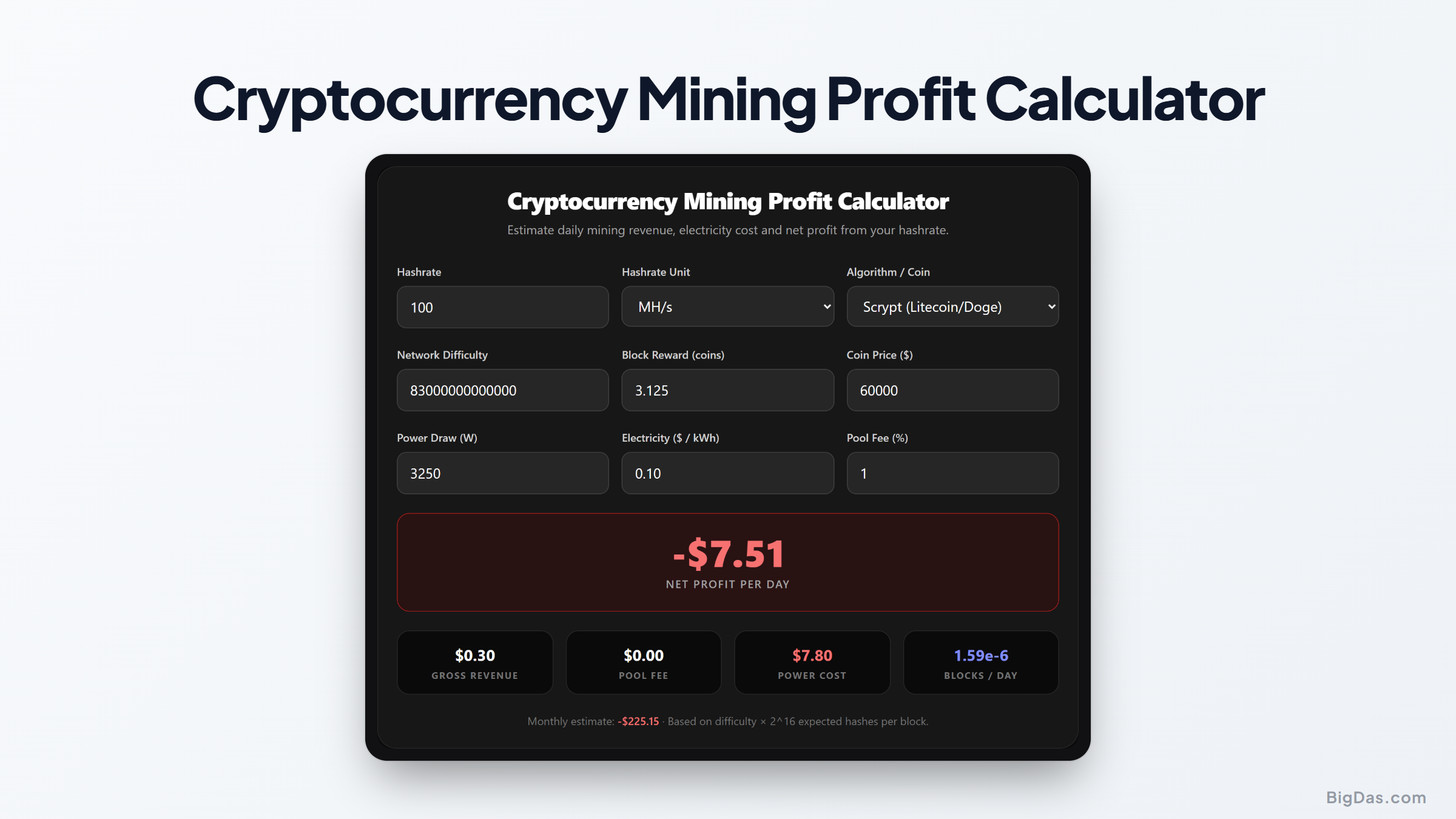
Cryptocurrency Mining Profit Calculator
 Generated infographic and interface snapshot for Cryptocurrency Mining Profit Calculator
Cryptocurrency Mining Profit Calculator: How to Estimate Revenue, Electricity Costs, and Yields
Mining digital assets looks simple on the surface. You buy hardware, plug it in, point it to a pool, and collect coin rewards. Building a profitable operation is more complicated. Volatile market prices, shifting difficulty levels, and daily utility bills can turn a promising setup into a money pit. A cryptocurrency mining profit calculator gives you a clear estimate of your real earnings before you commit capital. It combines hardware metrics, energy expenses, and network data into one number: your actual take-home profit. This applies whether you run a single home rig or manage a hosting facility.
What is a Cryptocurrency Mining Profit Calculator?
A cryptocurrency mining profit calculator is an interactive financial tool that estimates your net revenue from proof-of-work networks. It takes the technical parameters of your hardware setup and combines them with current network data to convert raw computing power into monetary values.
When you run a mining unit like an ASIC, your hardware performs trillions of mathematical attempts per second. This work consumes continuous electrical power. A bitcoin mining calculator takes these technical details and translates them into financial metrics. Instead of forcing you to work through formulas involving block rewards, difficulty scaling, and conversion rates, the tool automates the process. Key inputs include total hashrate, wattage draw, electricity rate per kilowatt-hour, and pool fee percentage. The output shows gross revenue, electricity costs, and net profit over daily, weekly, monthly, and annual timeframes.
Key Features and Benefits
An effective hashrate calculator gives miners total clarity over their balance sheets. Below are the primary features and advantages.
Precise Mining Electricity Cost Calculations
Power is the largest ongoing cost in crypto mining. A difference of a few cents per kilowatt-hour can flip a rig from profitable to unprofitable. The calculator isolates energy costs so you see exactly how much goes to the power utility each month.
Hardware Agnostic Hashrate Conversion
Hashrate units vary by network and hardware: MH/s, GH/s, TH/s, and PH/s. The calculator normalizes these inputs, so you can test different hardware builds without manual unit conversions.
ASIC Miner Profit Evaluation
New ASIC models ship regularly, each with different efficiency ratios in Joules per Terahash (J/TH). Enter the exact specs of an ASIC miner to see if a new, more efficient unit justifies the upfront cost compared to running an older one.
Customizable Pool Fees and Expenses
Solo mining can take months or years to find a block. Most miners join a pool for steady payouts. Pools charge fees, usually 1% to 3%. The calculator includes this parameter so net calculations match your actual payouts.
Real-Time Network Data Integration
Crypto networks adjust difficulty based on total active computing power. The calculator pulls current block reward amounts and difficulty settings automatically, so your estimates match current blockchain conditions.
Step-by-Step Guide: How to Use It
Here is how to model your financial outcomes.
Step 1: Choose Your Cryptocurrency or Algorithm
Select the coin you plan to mine: Bitcoin, Litecoin, Kaspa, etc. This loads the relevant network parameters, including current block rewards, network difficulty, and market price.
Step 2: Enter Your Hashrate
Input the total computing power of your equipment. Select the correct unit: TH/s for modern Bitcoin hardware, GH/s for some altcoins, MH/s for others.
Step 3: Input Power Consumption in Watts
Look up the power consumption of your hardware from the manufacturer spec sheet or a wall wattmeter. Enter the figure in the power field. A modern Bitcoin ASIC might draw around 3200 W.
Step 4: Set Your Local Electricity Rate
Enter your rate per kilowatt-hour ($/kWh). Include extra charges like transmission fees, delivery surcharges, or seasonal adjustments to keep the numbers realistic.
Step 5: Add Mining Pool Fees
Check the fee percentage charged by your pool and enter it. If you mine solo or run your own infrastructure, leave this at zero.
Step 6: Review Your Yield Projections
Review the breakdown once all variables are entered. Focus on the net profit section, which subtracts power costs and pool fees from gross revenue. Compare daily, monthly, and yearly figures to see how cash flow moves over time.
Why You Need This Tool: Primary Use Cases
Mining is capital intensive. Hardware purchases, facility setup, cooling, and power all cost money. Here is how different users put a calculator to work.
Evaluating New Hardware Purchases
Before spending thousands on a new ASIC, you need a break-even estimate. Plug the hardware specs into the calculator to get estimated daily returns and a payback period based on current market conditions.
Evaluating Hosting Facilities vs. Home Setups
Residential electricity rates are often too high for profitable mining. Many operators send machines to data centers with cheaper industrial power. A calculator lets you compare home mining profitability against third-party hosting packages that include power and maintenance fees.
Managing Operational Strategy During Bear Markets
When asset prices drop, margins shrink fast. Operators must check whether their machines are still generating positive net income. If power costs exceed gross revenue, running the hardware is a direct loss. The calculator helps you find the exact price threshold where you should pause operations.
Optimizing Power Usage and Efficiency
Many modern ASICs allow firmware tuning for low-power modes or underclocking. This reduces power draw at the cost of some hashrate. The calculator shows whether running at lower power yields better profit margins than running at maximum output.
Frequently Asked Questions
How does electricity cost impact mining profitability?
Electricity is the primary recurring cost in proof-of-work mining. Coin rewards depend on network share and price, but your power bill sets the floor. Dropping your rate from $0.10 to $0.06 per kWh can turn an unprofitable setup into a viable one.
Why does network difficulty change over time?
Networks adjust difficulty to keep block times consistent as computing power joins or leaves the chain. More miners online means higher difficulty and lower yield per TH/s. When hardware disconnects, difficulty drops and remaining units earn more.
What is the difference between revenue and net profit in mining?
Revenue is the total value of coins mined before expenses. Net profit is what remains after deducting electricity, pool fees, and other costs. A miner can generate significant revenue while running at a net loss if power costs exceed the value of the coins produced.
How accurate are mining calculators over long time horizons?
Calculators give an accurate snapshot of current conditions: difficulty, price, and block reward. Long-term projections (6 to 12 months) are estimates because prices and difficulty change constantly. Run multiple scenarios with conservative assumptions when planning long term.
What parameters matter most when calculating ASIC miner profit?
The two critical factors are electrical efficiency (W/TH) and your local power cost ($/kWh). Hashrate determines total revenue, but efficiency and utility pricing determine how much of that revenue becomes net profit.
Final Thoughts
Profitability in crypto mining comes down to precise planning and disciplined expense management. Guessing at earnings without accounting for power draw, pool fees, and network difficulty leads to poor capital allocation. A cryptocurrency mining profit calculator lets you test hardware investments, compare utility rates, and adjust your operational strategy as conditions change. Base decisions on clear math, not speculation, and your operation stands a better chance of long-term stability.