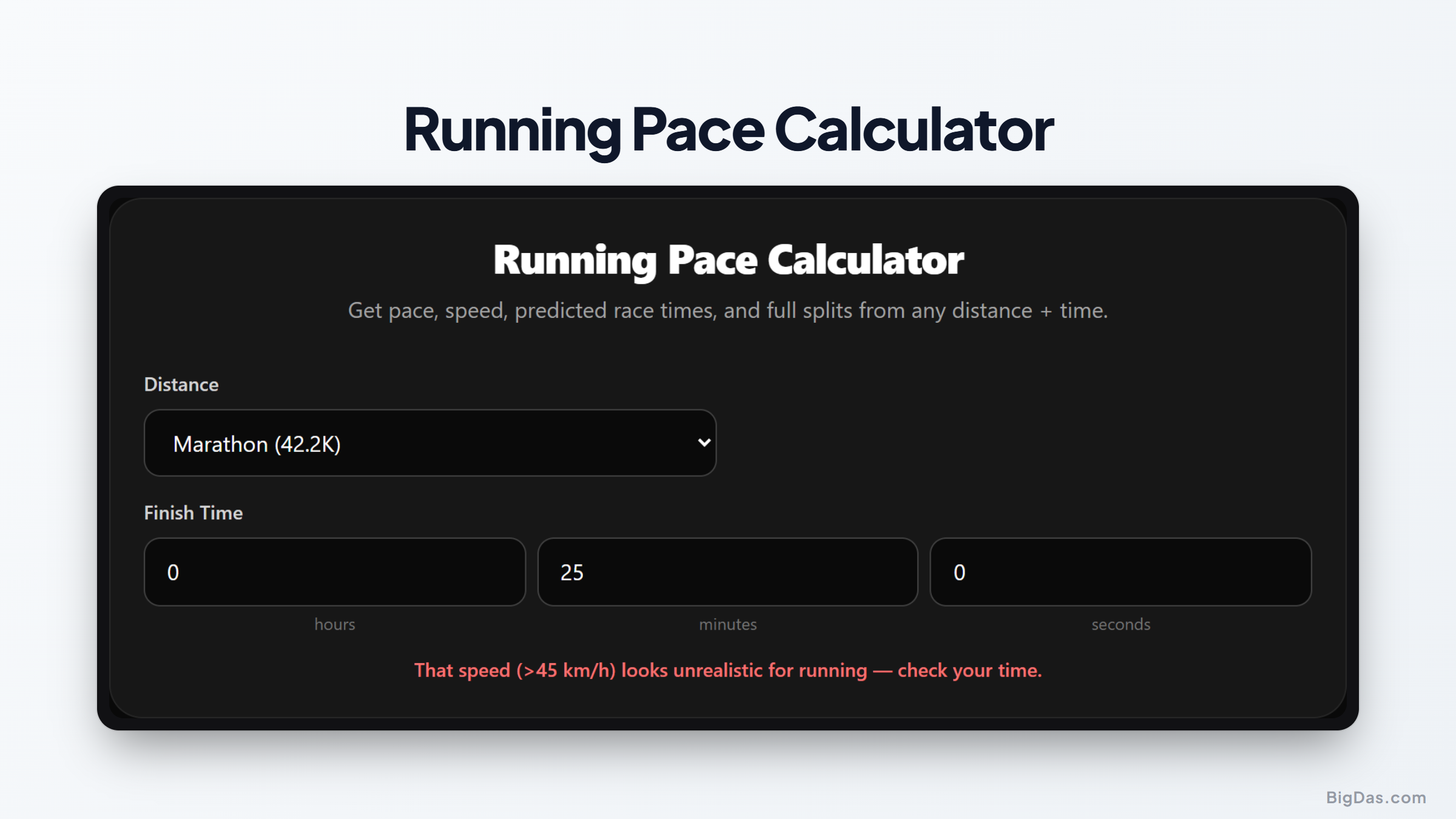
Running Pace Calculator
Generated infographic and interface snapshot for Running Pace Calculator

How to Calculate Your Running Pace: A Guide to Predicting Race Times and Setting Split Goals
Every runner, whether preparing for a first local event or aiming for a personal record in a major marathon, eventually runs into the same core questions. How fast should I run? What is my projected finish time? How do I structure training runs to reach specific performance goals?
Understanding your speed and timing is the foundation of smart training. This is where a reliable running pace calculator becomes an essential tool. Instead of guessing your target times or attempting complex math during a run, you can use a structured calculator to analyze your performance and set realistic goals.
Using performance data helps you train smarter, prevent injury, and ensure you cross the finish line with energy to spare.
What is a Running Pace Calculator?
A running pace calculator is a digital tool designed to help runners understand the relationship between distance, time, and speed. At its core, pace refers to the amount of time it takes to cover a specific distance, typically expressed in minutes per mile or minutes per kilometer.
The calculator takes any two known variables among distance, time, and pace, and automatically calculates the third. For example, if you know you want to run a 10 kilometer race in 50 minutes, the tool will instantly show you the exact running pace you need to maintain.
By removing the guesswork from training, a pace calculator allows you to focus entirely on your physical preparation and mental focus.
Key Features and Benefits of the Tool
This specific calculator is built to support runners of all experience levels by providing several essential calculations in one place.
Comprehensive Pace and Speed Conversion
Whether you prefer to track your runs in miles or kilometers, the tool handles conversions seamlessly. It displays your pace in both formats alongside your average speed in miles per hour or kilometers per hour. This is especially helpful if you train on a treadmill that uses speed settings rather than pace metrics.
Advanced Race Time Predictor
Planning for a new distance can be challenging. If you have only run 5 kilometer races, how do you know what to expect during a half marathon? The calculator uses an established mathematical model known as the Riegel formula to predict your finish times across various standard race distances based on your current performance.
Detailed Splits Calculator
A split is the time it takes to complete a specific portion of a run, such as each mile or kilometer. Maintaining an even pace is often the most efficient way to run a race. The calculator generates a full list of splits for your target distance, showing you exactly where you need to be at every milestone to achieve your goal time.
The Science Behind the Prediction: The Riegel Formula
To predict how a runner will perform at a new distance, the calculator relies on the Riegel formula. Developed by research engineer Peter Riegel in 1977, this formula has remained a standard in sports science for predicting race times.
The formula is designed to account for the natural fatigue that occurs as a runner covers longer distances. It acknowledges that you cannot maintain your 5k pace over the course of a full marathon.
The mathematical expression of the formula is written as follows:
T2 = T1 × (D2 ÷ D1)^1.06
In this equation, T1 represents your recent race time, and D1 is the distance of that race. D2 is the target distance you want to run, and T2 is the predicted time for that new distance.
The exponent of 1.06 is the key to this formula. It represents a fatigue factor that applies to most endurance athletes. It assumes a slight, predictable decline in average speed as the distance increases. While individual factors like aerobic capacity, weather, and training volume can influence your actual results, the Riegel formula provides a highly accurate baseline for most runners.
Step by Step Guide on How to Use the Calculator
Using the calculator is simple and takes only a few moments. Here is how you can get the most out of the tool.
Step 1: Enter Your Reference Distance and Time
Start by inputting a recent run or race performance. Choose a distance that you have completed recently under good conditions. Enter the hours, minutes, and seconds it took you to finish that distance.
Step 2: Select Your Target Units
Choose whether you want to view your results in miles or kilometers. You can switch between these units at any time to compare metrics easily.
Step 3: Review Your Running Pace and Speed
The calculator will instantly display your average running pace and speed. This information is valuable for setting your current training zones.
Step 4: Explore Your Predicted Race Times
Look at the race time predictor section. Based on your input, the tool will display estimated finish times for common race distances, including the 5 kilometer, 10 kilometer, half marathon, and full marathon.
Step 5: Analyze Your Split Times
Review the splits calculator output. This section breaks down your target run into individual miles or kilometers. You can use these splits to monitor your progress during training runs or to pace yourself on race day.
Why You Need This Tool: Common Use Cases
A running pace calculator is not just for race day. It is a versatile tool that can be used throughout your entire training cycle.
Determining Your Training Zones
Effective training requires running at various intensities. To improve your aerobic capacity, you must run your easy runs slow enough to recover, and your speed workouts fast enough to stimulate adaptation. By calculating your current pace, you can easily determine your target paces for recovery runs, tempo runs, and interval sessions.
Setting a Realistic Marathon Pace
One of the biggest mistakes runners make during a marathon is starting too fast. This often leads to hitting the wall in the later stages of the race. By using the Riegel formula predictions, you can establish a realistic marathon pace that matches your current fitness level, helping you conserve energy and finish strong.
Developing a Race Day Strategy
Once you have a target finish time in mind, you can use the splits calculator to create a pacing plan. If you know the exact time you need to hit at each mile marker, you can avoid the temptation to run too fast early in the race when your adrenaline is high.
Tracking Fitness Progress Over Time
As you progress through your training program, your fitness will improve. By entering your workout data into the calculator every few weeks, you can watch your average running pace decrease and your predicted race times improve. This provides clear, objective evidence of your hard work paying off.
Frequently Asked Questions
How accurate is the race time predictor?
The predictor uses the Riegel formula, which is highly accurate for most runners who have trained adequately for their target distance. However, it assumes you have done the appropriate endurance training for the longer distance. For example, if you can run a fast 5K but have not done any long runs, your actual marathon time may be slower than the prediction.
What is the difference between pace and speed?
Pace is the amount of time it takes to cover a set distance, usually measured in minutes per mile or minutes per kilometer. Speed is the distance covered in a set amount of time, measured in miles per hour or kilometers per hour. Runners typically use pace because it is easier to track using a watch while moving.
Why do my split times matter?
Splits help you monitor whether you are running at an even rate. Running even splits means completing each segment of your run in the same amount of time. This is widely considered the most energy efficient way to run a race, as sudden changes in speed waste valuable energy.
Can I use this calculator for trail running?
While you can use the calculator for trail runs, keep in mind that elevation changes, terrain, and weather will naturally slow your pace. The calculator assumes flat, paved surfaces and good weather conditions. For trail running, use the results as a loose guide rather than an absolute rule.
How do I improve my running pace?
To run faster, you must combine consistent aerobic training with targeted speed workouts. Adding weekly interval training, hill repeats, and tempo runs to your routine will gradually improve your cardiovascular efficiency and muscular strength, leading to a faster overall pace.
Here is What to Know
Pacing is one of the most critical aspects of running. Whether you are aiming to complete your first 5K or aiming for a personal record in the marathon, understanding your numbers is key to smart training and successful racing.
By utilizing a running pace calculator, you gain access to vital insights regarding your current speed, predicted race outcomes, and milestone splits. This data allows you to train with clear intentions, avoid common pacing errors, and ultimately achieve your athletic goals with greater confidence. Use these calculations to guide your daily runs, structure your weekly workouts, and approach your next starting line with a clear, realistic plan.
