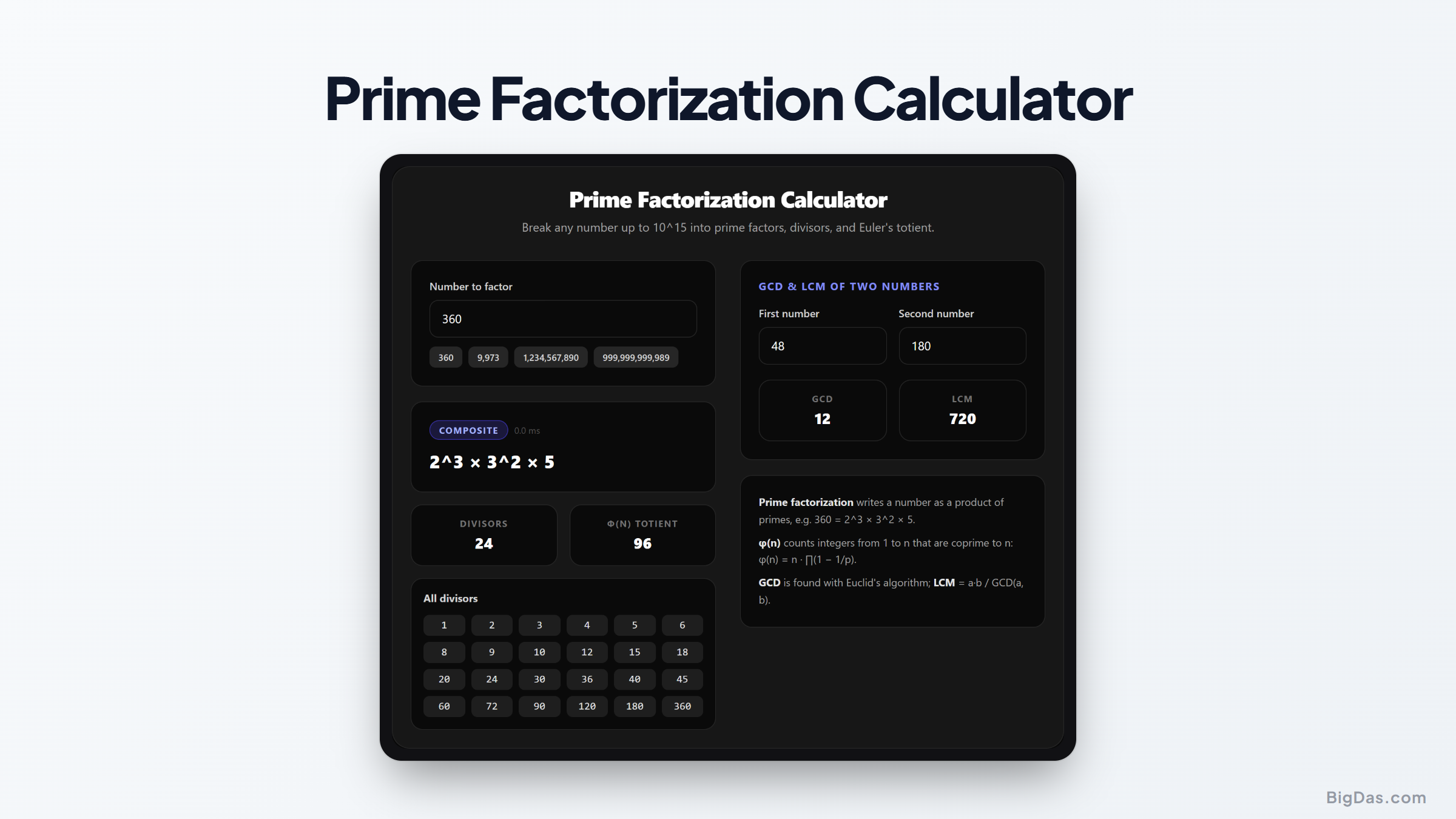
Prime Factorization Calculator
 Generated infographic and interface snapshot for Prime Factorization Calculator
How to Decompose Large Numbers Instantly with a Prime Factorization Calculator
Breaking down a twelve-digit number by hand is slow and error-prone. A dedicated prime factors calculator handles this in milliseconds and gives you more than just a list of primes.
What is a Prime Factorization Calculator?
A prime factorization calculator breaks any composite integer into its prime components. This tool supports integers up to 10^15 (one quadrillion).
Beyond the basic prime list, the calculator outputs:
- The prime factorization with exponents
- A visual factor tree
- The complete list of divisors
- GCD, LCM, and Euler's totient function
The Mathematics of Decomposition
Every whole number greater than 1 is either prime or can be written as a unique product of primes. This is the Fundamental Theorem of Arithmetic. Prime numbers are the building blocks because they cannot be factored further.
For example, the number 60 factors as:
2 × 2 × 3 × 5
Grouping identical primes with exponents gives:
2² × 3¹ × 5¹
This exponential format keeps large factorizations readable. The number 1200, for instance, becomes:
2⁴ × 3¹ × 5²
Key Features of the Prime Factors Calculator
Visual Factor Tree Generator
A factor tree shows the decomposition as a hierarchical diagram. The main number splits into smaller factors, and the branches continue until only primes remain at the tips. This is useful for teaching factorization to students.
Comprehensive List of Divisors
The tool lists every divisor of a number. For 12, it outputs 1, 2, 3, 4, 6, and 12, removing the need to test divisions manually.
Integrated GCD and LCM Calculator
- Greatest Common Divisor (GCD): The largest positive integer that divides each of the entered integers.
- Least Common Multiple (LCM): The smallest positive integer divisible by all the entered numbers.
The calculator derives both values from the prime factors:
LCM(a, b) = (a × b) ÷ GCD(a, b)
Euler's Totient Function Computer
Euler's totient function, written as φ(n), counts the positive integers up to n that share no common factors with n other than 1. The calculator computes this from the prime factors using:
φ(n) = n × (1 - 1/p1) × (1 - 1/p2) × .. × (1 - 1/pk)
where p1, p2, and pk are the unique prime factors.
Step by Step Guide to Using the Calculator
Step 1: Enter Your Number
Type the integer you want to analyze into the input field. The calculator accepts any positive integer up to 10^15.
Step 2: Add Additional Numbers (Optional)
To use the GCD and LCM feature, enter a second or third number in the designated fields.
Step 3: Click Calculate
Press the calculate button. The algorithms run instantly.
Step 4: Review the Results
The page displays:
- The prime factorization in standard and exponential format
- The visual factor tree
- The complete list of divisors
- The Euler totient value
- The GCD and LCM (if you entered multiple numbers)
Practical Applications and Use Cases
Computer Science and Cryptography
RSA encryption, which secures most online transactions, is built on the difficulty of factoring very large numbers. Programmers and security students use prime factorization and Euler's totient to understand key generation and encryption.
Simplifying Fractions and Ratios
Simplifying fractions requires finding the GCD of the numerator and denominator. The GCD/LCM feature reduces fractions to their simplest form in one step.
Scheduling and Event Planning
The LCM solves scheduling problems. If one event occurs every 6 days and another every 8 days, both occur on the same day every 24 days, which is LCM(6, 8).
Database Design and Hashing
Distributing data evenly across shards or buckets often uses prime numbers to minimize clustering. Developers use the calculator to find primes near a target capacity.
Frequently Asked Questions
What is prime factorization?
Prime factorization finds which prime numbers multiply together to equal the original number. Unlike regular factoring, it only uses primes like 2, 3, 5, 7, and 11.
How does the factor tree help in learning?
A factor tree shows the step-by-step breakdown of a composite number, making it easier to see how multiplication and division relate.
What is the significance of Euler's totient?
Euler's totient is a core function in number theory. It is used in cryptography to compute the multiplicative inverse in modular arithmetic, which secures data transmission.
Can this tool handle prime numbers?
Yes. If you enter a prime, the calculator identifies it as prime. The factorization is the number itself, and the divisors are 1 and the number itself.
What does it mean for two numbers to be coprime?
Two numbers are coprime (or relatively prime) if their GCD is 1. They share no common factors other than 1. Euler's totient counts how many numbers below n are coprime to n.
How does the calculator find all divisors of a number so quickly?
The tool uses optimized trial division and factorization algorithms. Instead of checking every integer sequentially, it applies mathematical shortcuts to return results in real time.
Summary
This prime factors calculator analyzes any integer up to 10^15 quickly and accurately. It produces a factor tree, lists divisors, and computes Euler's totient, GCD, and LCM, making it a practical resource for students, teachers, developers, and math enthusiasts.