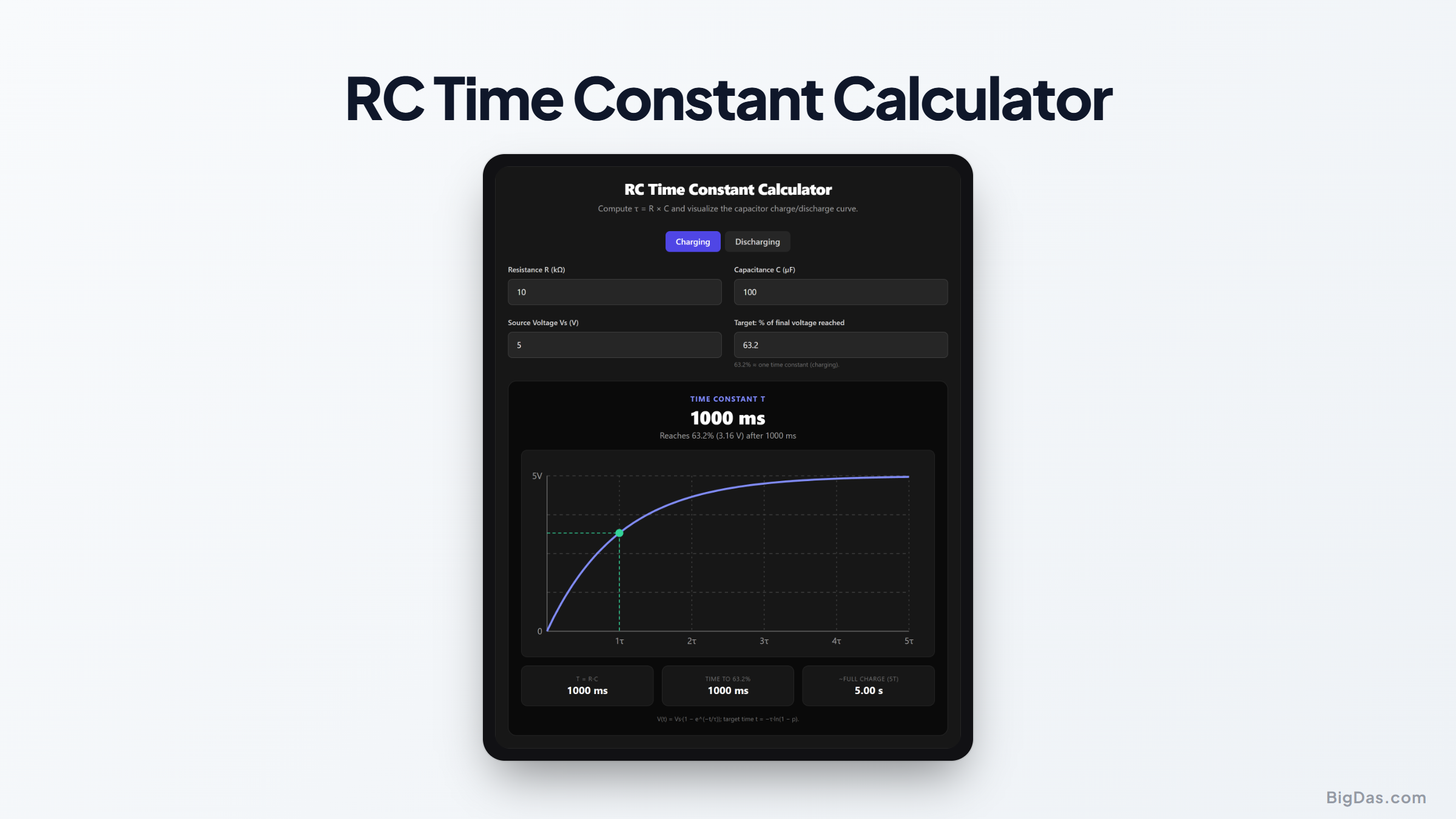
RC Time Constant Calculator
 Generated infographic and interface snapshot for RC Time Constant Calculator
Charge and discharge curves of an RC circuit, solved in your browser.
Free RC Time Constant Calculator Online. Big Das
The Big Das RC Time Constant Calculator computes tau (τ = R×C) from your resistor and capacitor values, graphs the charge/discharge curve, and finds the time to reach any target voltage.
What Is the RC Time Constant?
When a resistor and capacitor are connected in series, the capacitor doesn't charge instantly, it follows an exponential curve. The time constant τ (tau) is the product of resistance and capacitance:
- After 1τ, a charging capacitor reaches about 63.2% of the supply voltage.
- After ~3τ, it reaches about 95%.
- After 5τ, it reaches about 99.3%, effectively full for most purposes.
The same curve runs in reverse when discharging: after 1τ, the capacitor holds only 36.8% of its starting voltage. Tau has units of seconds (ohms × farads), so a 10 kΩ resistor with a 100 µF capacitor gives τ = 1 second.
Why Tau Matters
Tau turns an intimidating exponential into a handful of memorable milestones. Know tau, and you can predict timing delays, filter cutoff behavior, and debounce response without solving any equations.
How to Use the RC Time Constant Calculator
- Enter the resistance (R): the series resistor charging or discharging the capacitor, in ohms, kΩ, or MΩ.
- Enter the capacitance (C): in farads, µF, nF, or pF.
- Enter the supply or starting voltage: the source voltage Vs for charging, or the initial voltage V0 for discharging.
- Pick a target percentage: for example, 63.2% to find one tau, or any custom percentage of full charge.
- Read the results: tau, the time to reach your target voltage, and a live graph of the full charge/discharge curve.
The Formulas Used
tau = R × C (seconds, with R in ohms, C in farads)

Charging: V(t) = Vs × (1 - e^(-t / tau))
Discharging: V(t) = V0 × e^(-t / tau)

Time to reach a target percentage when charging:
t = -tau × ln(1 - target)

Handy milestones (of Vs when charging):
t = 1 tau → 63.2%
t = 3 tau → 95.0%
t = 5 tau → 99.3%
Worked Example
Say you have a 10 kΩ resistor charging a 100 µF capacitor from a 5 V supply:
- tau = 10,000 × 0.0001 = 1 second
- At t = 1 s: V = 5 × (1 − e^(−1)) ≈ 5 × 0.632 = 3.16 V
- At t = 3 s: V ≈ 4.75 V (95%)
- At t = 5 s: V ≈ 4.97 V (99.3%)
Now suppose a microcontroller input needs to see a logic-high threshold of 3.5 V, that's 70% of Vs. The time to reach it:
t = −1 × ln(1 − 0.70) = −ln(0.30) ≈ 1.20 seconds
Swap the resistor for 100 kΩ and every time multiplies by ten, the calculator makes exploring trade-offs instant.
Common Use Cases
- Power-on reset circuits: Set how long a reset line stays low after power-up.
- Switch debouncing: Size R and C so contact bounce settles before the logic threshold is crossed.
- RC filters: Estimate how fast a low-pass filter's output responds to a step input.
- Timing delays: Create a predictable delay before a transistor, comparator, or MCU pin triggers.
- Camera flashes and pulse circuits: Predict how quickly a capacitor bank charges or dumps its energy.
Frequently Asked Questions
What exactly is tau?
Tau (τ = R × C) is the time constant of an RC circuit, measured in seconds. It's the time a charging capacitor takes to reach 63.2% of the supply voltage, or a discharging one to fall to 36.8% of its starting voltage.
Why does charging stop being linear?
The charging current depends on the voltage difference between the supply and the capacitor. As the capacitor fills, that difference shrinks, so the current, and the rate of charge, tapers off exponentially.
Is a capacitor ever fully charged?
Mathematically, never, the exponential approaches the supply voltage asymptotically. In practice, engineers call the capacitor "full" at 5τ (99.3%) or even 3τ (95%) for less precise work.
Does tau change with the supply voltage?
No. Tau depends only on R and C. A higher supply voltage changes the final voltage and the current, but the shape of the curve, measured in time constants, stays the same.
Can I use this for discharging too?
Yes. The same tau governs discharge: V(t) = V0 × e^(−t/τ). Give the calculator a starting voltage and it shows how long until the capacitor falls to any target percentage.
What units should I enter?
Enter resistance in ohms, kΩ, or MΩ and capacitance in µF, nF, or pF, the tool converts everything to ohms and farads internally, so tau always comes out in seconds.