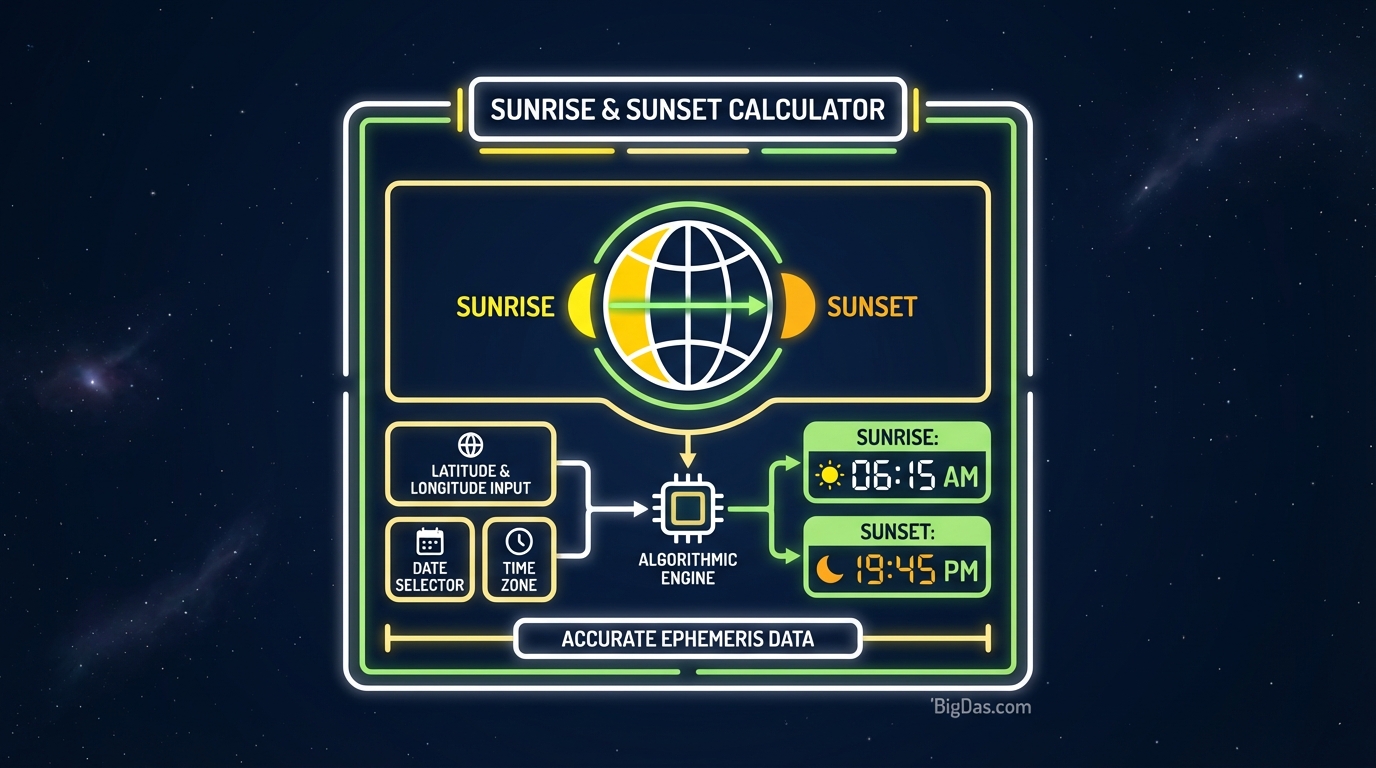
Sunrise & Sunset Calculator
 Modern scientific illustration of Sunrise & Sunset Calculator
Sunrise & Sunset Calculator with Real-Time Sun Path Visualization
Standard weather apps tell you the time of sunrise and sunset, but they don't give you the underlying solar mechanics. The Sunrise & Sunset Calculator uses precise astronomical algorithms and your exact coordinates to compute solar noon, twilight phases, and day length. It also plots a real-time sun path so you can see where the sun sits in the sky right now and where it is headed.
What is the Sunrise & Sunset Calculator?
The Sunrise & Sunset Calculator is a browser tool that computes the position of the sun relative to the horizon for any location and date. It uses latitude, longitude, and elevation rather than referencing the nearest weather station. The algorithm accounts for the curvature of the earth, the equation of time, and atmospheric refraction, so the results are accurate to the second.
The interface includes a Real-Time Sun Path Visualization that draws the sun's arc across the sky. A marker tracks the sun's current position, and shaded bands show the boundaries of night, civil twilight, nautical twilight, and astronomical twilight.
Key Features
1. Geolocation Precision
The tool detects your location through the browser's geolocation API (with your permission) or accepts manual coordinate and city input. Solar events are calculated for your exact position, not for a city center miles away.
2. Solar Data Points
- Sunrise & Sunset: The moment the upper limb of the sun crosses the horizon.
- Solar Noon: The time the sun crosses the local meridian. This is rarely at 12:00 PM clock time because of time zone offsets and Daylight Saving Time.
- Day Length: Total duration of sunlight, in hours, minutes, and seconds.
- Twilight Phases: Civil, Nautical, and Astronomical twilight boundaries.
3. Real-Time Sun Path Visualization
The chart plots the sun's altitude versus time for the selected day. The current position is marked in real time, and the area under the curve is shaded to distinguish full daylight from twilight and night. You can read the remaining daylight at a glance.
4. Day Length Delta
The tool reports the difference in day length between today and yesterday. This is useful for tracking the approach of the solstices and equinoxes.
Use Cases
Photographers and Videographers
- Golden Hour: The period shortly after sunrise and before sunset when light is warm and soft.
- Blue Hour: The twilight window used for cityscapes and atmospheric shots.
- Shadow Placement: Predict shadow direction at solar noon for portrait and architectural work.
Hikers, Campers, and Runners
- Trip Timing: Set turnaround times before sunset to avoid hiking in the dark.
- Campsite Selection: Pick sites that catch morning sun or evening shade based on the sun path.
Architects and Real Estate
- Natural Light: Determine which rooms get morning versus afternoon light.
- Solar Panels: Estimate peak sun hours around solar noon for sizing PV arrays.
Health and Circadian Rhythms
- Morning Light: Plan outdoor light exposure for cortisol and melatonin regulation.
- UVB Availability: Use solar noon as a proxy for peak UVB, while observing sun safety.
Gardeners and Farmers
- Photoperiod Check: Confirm that your latitude provides the day length required by specific crops.
How to Use the Calculator
Step 1: Open the Tool
Load the page in any modern desktop or mobile browser. No installation is required.
Step 2: Set Your Location
Click "Use Current Location" to grant GPS access, or enter a city, address, or zip code for a different site.
Step 3: Read the Dashboard
- Top: Sunrise and sunset in large numerals.
- Center: Sun path chart with the live position marker.
- Data Grid: Solar noon, day length, and twilight times.
- Bottom: Day length delta compared to yesterday.
Tips for Getting More From the Tool
1. Solar Noon vs. 12:00 PM Solar noon can fall between 11:30 AM and 1:30 PM depending on your position within the time zone and whether DST is active. Schedule activities that need maximum sun angle around solar noon rather than clock noon.
2. Use Civil Twilight as a Buffer Civil twilight provides enough light to work outdoors without artificial lighting. Treat the end of civil twilight as your effective cutoff for tasks like setting up camp.
3. Compare Solstices Run the calculator for June 21 and December 21 to see the extremes of day length at your latitude. This helps with seasonal planning for gardens, shading, and solar installations.
Frequently Asked Questions (FAQ)
Q1: How accurate is the Sunrise & Sunset Calculator?
A: The tool uses NOAA-standard solar position algorithms. Accuracy is typically within one second for the geometric events. Actual visibility depends on local terrain and weather.
Q2: What is the difference between Sunrise and Dawn?
A: Sunrise is when the upper edge of the sun appears on the horizon. Dawn (specifically astronomical dawn) occurs earlier, when the sun is 18 degrees below the horizon and the sky begins to lighten.
Q3: Why does the day length change every day?
A: The Earth's axial tilt of 23.5 degrees causes the day length to vary as the planet orbits the sun. The calculator tracks this change precisely.
Q4: Does the tool account for Daylight Saving Time?
A: Yes. The calculator applies the time zone and DST rules for the selected location.
Q5: Can I use this for religious prayer times?
A: Yes. The tool provides the twilight and sunset data used for prayer times such as Fajr and Maghrib.
Summary
The Sunrise & Sunset Calculator delivers the solar data that weather apps skip: solar noon, twilight boundaries, and a live sun path chart tied to your exact coordinates. It is useful for photography, outdoor planning, architecture, health, and agriculture.
Bookmark the tool and check the sun path before scheduling your next shoot, hike, or project that depends on daylight.