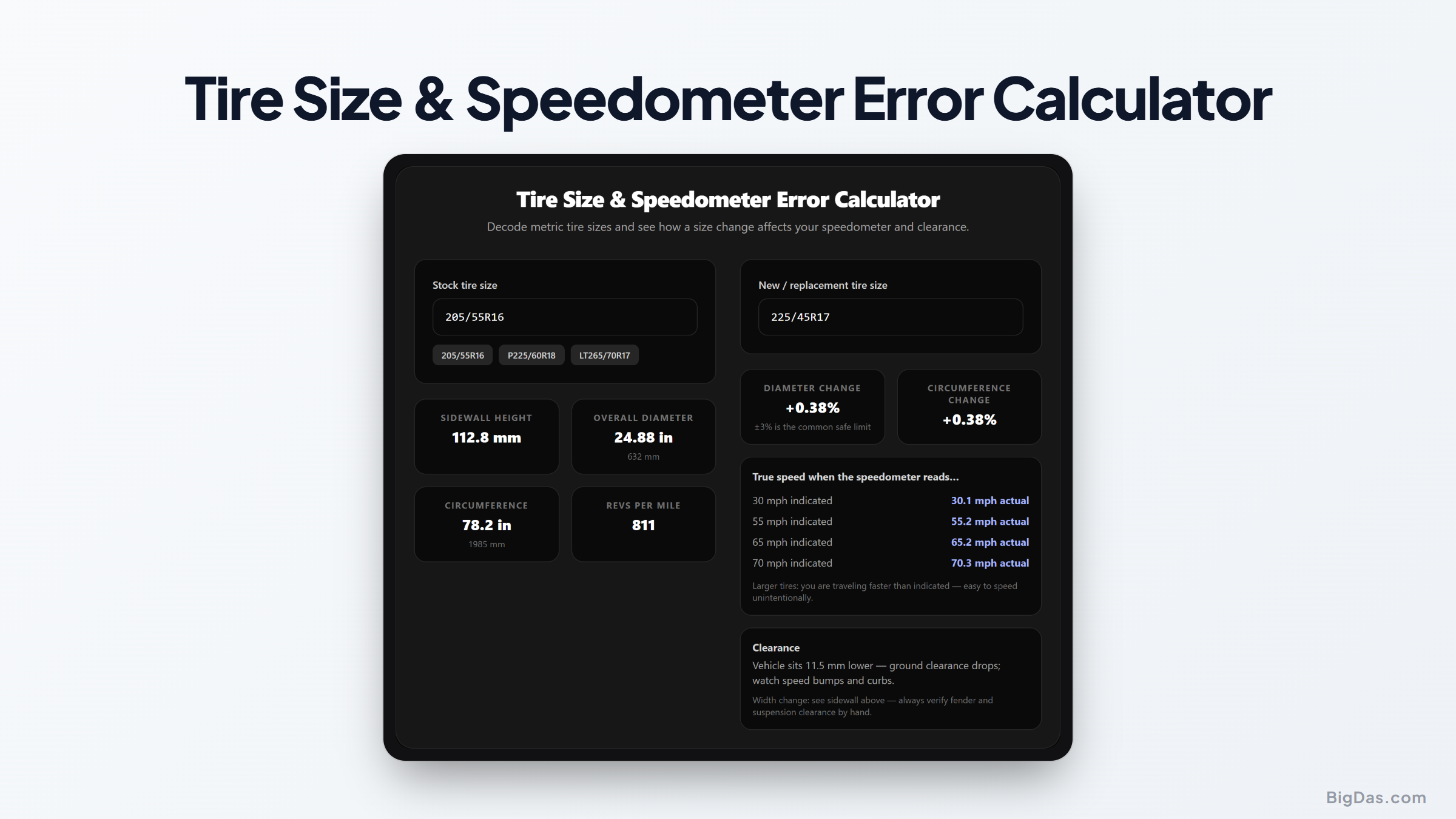
Tire Size & Speedometer Error Calculator
 Interface snapshot for Tire Size & Speedometer Error Calculator
Choosing the Right Tire Size: How to Compare Dimensions and Prevent Speedometer Error
When it is time to replace the tires on your vehicle, you might think about sticking to the exact size that came from the factory. Many drivers, however, want to explore other options. Perhaps you want a smoother ride, better cornering capability, or a more aggressive look for your truck. If you change your tire size without understanding the physical dimensions, you can cause unexpected issues with your vehicle.
This is where a tire size calculator helps. Changing the overall diameter of your tires impacts your speedometer accuracy, your odometer, your gear ratios, and your ground clearance. Understanding how these measurements interact lets you make informed decisions that keep your vehicle safe and performing as intended.
What is a Tire Size and Speedometer Error Calculator?
A tire size and speedometer error calculator is an online tool that compares two different tire specifications. It decodes the metric tire code on the sidewall of your tires, such as 205/55r16, and converts those numbers into physical measurements in inches or millimeters.
Enter your current tire size and a proposed new size, and the tool computes the differences in width, sidewall height, overall diameter, and tire circumference. It also calculates how these dimensional changes affect your speedometer reading, so you can see whether your vehicle will actually be traveling faster or slower than what the dashboard shows.
Decoding the Metric Tire Code
To understand how the calculator works, it helps to know what the numbers on your tire sidewall mean. Consider a common tire size: 205/55r16.
The first number, 205, is the section width of the tire in millimeters. This is the span from sidewall to sidewall at the widest point of the tire.
The second number, 55, is the aspect ratio. This is a percentage that represents the height of the sidewall relative to the width. Here, the sidewall height is 55 percent of 205 millimeters, which is 112.75 millimeters.
The letter R stands for radial construction, standard on nearly all modern passenger vehicles.
The final number, 16, is the diameter of the wheel rim in inches.
Because tire sizes mix metric millimeters and imperial inches, calculating the overall tire diameter by hand is awkward. The calculator handles the unit conversion and arithmetic for you.
Key Features and Benefits
Side by side comparison: See how two different tire sizes stack up. The tool highlights the exact differences in width, diameter, and circumference.
Speedometer correction values: Larger or smaller tires will cause your speedometer to read incorrectly. The calculator shows the speedometer error percentage, which helps you avoid speeding tickets and keep your travel times accurate.
Ground clearance adjustments: Changing tire height affects how high your vehicle sits off the ground. The calculator tells you exactly how much your ground clearance will increase or decrease.
Plus size exploration: For those upgrading to larger wheels with lower profile tires, the tool helps find alternative sizes that maintain the original overall diameter.
The Math Behind the Calculations
The tool uses standard geometric formulas. To calculate the total tire diameter:
Tire Diameter = (Width × Aspect Ratio × 2 ÷ 25.4) + Wheel Diameter
To calculate the tire circumference:
Circumference = Tire Diameter × π
In these formulas, the width is multiplied by the aspect ratio percentage and by two because there is a sidewall at the top and the bottom of the wheel. The result is divided by 25.4 to convert millimeters into inches, and then the wheel diameter is added. Finally, the total diameter is multiplied by pi (approximately 3.14159) to find the tire circumference.
Once the calculator has the circumference of both tires, it determines the speedometer error. Your speedometer is calibrated to count tire rotations based on the original tire circumference, so a larger tire travels further with each rotation, making the speedometer read slower than your actual speed.
Step by Step Guide
Using the tire size calculator is straightforward.
First, locate your current tire size. It is printed on the sidewall of your current tires, on a placard inside the driver side door jamb, or in your vehicle owner manual. Assume your stock size is 205/55r16.
Second, enter these three numbers into the original tire section of the calculator.
Third, enter the dimensions of the new tire size you are considering. For example, you might switch to a wider 225/50R16 tire.
Fourth, view the results. The calculator generates a comparison chart showing the differences in diameter, width, circumference, and sidewall height.
Fifth, check the speedometer error section. It will display your actual speed when your speedometer reads a specific speed, such as 60 miles per hour, so you can confirm the new size fits within safe operating parameters.
Why You Need This Tool: Key Use Cases
Upgrading to Plus Size Tires
Plus sizing involves fitting larger wheels with wider, lower profile tires. This improves cornering stability and gives the vehicle a sportier appearance. To prevent rubbing against the suspension or fenders, the new tire circumference should stay as close to the original as possible.
Off Road Modifications
Truck and SUV owners often want taller tires for increased ground clearance and better traction in mud or snow. A significant increase in tire diameter will cause a notable speedometer error and can affect transmission shift points. Knowing the exact difference helps you decide if you need to recalibrate the vehicle computer or change gear ratios.
Finding Alternative Sizes During Shortages
When your exact tire size is out of stock, the calculator helps you find a safe alternative for your existing wheels without compromising safety systems like ABS or stability control.
Odometer Accuracy
A tire with a larger circumference rotates fewer times per mile. Your odometer will record fewer miles than you actually drove, which complicates maintenance intervals and affects resale value calculations.
Frequently Asked Questions
What is the 3 percent rule for tire sizes?
Most tire experts recommend keeping the change in overall tire diameter within 3 percent of the original factory tire size. Staying within this limit keeps the speedometer reasonably accurate and prevents interference with electronic safety systems like traction control and ABS.
How does tire diameter affect my speedometer?
Your speedometer measures how fast your transmission or wheel hubs are spinning, not how fast the vehicle moves across the ground. Larger tires cover more ground per rotation, so the vehicle moves faster than the speedometer shows. Smaller tires cause the speedometer to read faster than your actual speed.
Will changing my tire size void my warranty?
Minor changes within the recommended 3 percent range generally do not affect your warranty. Extreme changes that require suspension modifications or cause mechanical strain can void parts of your vehicle warranty. Consult your vehicle manual or a certified mechanic before making drastic changes.
What is tire circumference and why does it matter?
Tire circumference is the distance around the outside edge of the tire tread. It represents the actual distance your car travels during one complete rotation of the wheel. It is the key measurement for calculating speedometer error and odometer differences.
Can I run different tire sizes on the front and back of my vehicle?
Some high performance vehicles come from the factory with wider tires on the rear axle, known as a staggered setup. On standard front wheel drive, rear wheel drive, or all wheel drive vehicles, mixing tire diameters can cause severe damage to the drivetrain, differential, and traction control systems.
Summary
Understanding your tire dimensions is part of vehicle maintenance and modification. Whether you are upgrading to plus size tires for better performance, fitting a taller tire for off road use, or finding a compatible alternative size, a tire size calculator simplifies the process. By checking the speedometer error, overall diameter, and tire circumference before making a purchase, you keep your vehicle safe, efficient, and compliant with local traffic laws. A few minutes of comparison online can save you from clearance issues and unexpected speeding tickets.