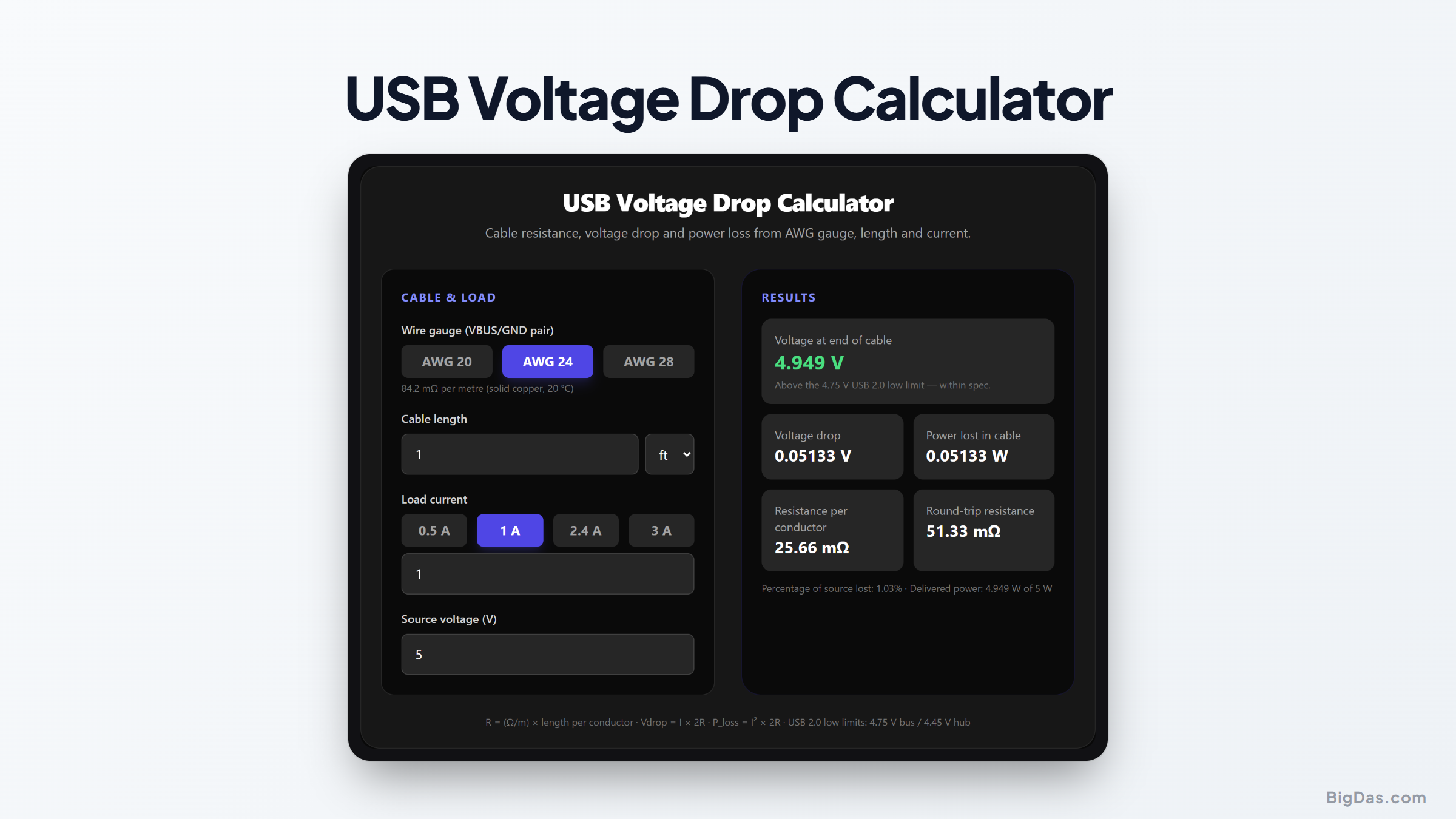
USB Voltage Drop Calculator
 Generated infographic and interface snapshot for USB Voltage Drop Calculator
Why does the 5 V leave the charger but only 4.5 V reach the phone? Cable resistance.
Free USB Voltage Drop Calculator Online. Big Das
The Big Das USB Voltage Drop Calculator computes round-trip cable resistance from AWG gauge and length, then shows voltage drop, power loss, and end-of-cable voltage against USB 2.0's 4.75 V and 4.45 V low limits.
What Is USB Cable Voltage Drop?
USB power travels down a pair of thin wires: VBUS and GND. Both have resistance, so under load the voltage at the device end sags by I × 2R. Cheap cables with skinny conductors (AWG 28) lose over a volt at fast-charge currents, causing slow charging, brownouts, and "this accessory may not be supported" warnings.
How to Use the Calculator
- Select the wire gauge: AWG 20, 24, or 28.
- Enter the cable length in metres or feet.
- Pick a current preset (0.5 A, 1 A, 2.4 A, or 3 A) or enter your own.
- Optionally adjust the source voltage (5 V default).
- Read voltage drop, power loss in the cable, and the voltage actually delivered, with a green/amber/red verdict against the USB spec limits.
Formulas Used
Per-conductor resistance:
R = (Ω/m) × length (copper at 20 °C)

Round-trip resistance (VBUS + GND):
R_rt = 2 × R

Voltage drop:
Vdrop = I × R_rt

Power lost in cable:
P = I × Vdrop = I² × R_rt

Voltage at device:
Vend = Vsource − Vdrop

USB 2.0 low limits (§7.2.2):
4.75 V, powered hub / host port minimum
4.45 V, low-power device behind a bus-powered hub
Worked Example
A 1 m cable using AWG 24 conductors (0.0842 Ω/m) charging at 1 A:
- R per conductor = 0.0842 Ω, round trip = 168.4 mΩ
- Vdrop = 1 × 0.1684 = 0.168 V → device sees 4.83 V, in spec, 0.17 W wasted.
Swap to a bargain AWG 28 cable (0.213 Ω/m) at 2.4 A:
- Vdrop = 2.4 × 2 × 0.213 = 1.02 V → only 3.98 V reaches the device, far below the 4.45 V floor, and 2.45 W cooks the cable.
Even a good cable suffers at high current: AWG 24, 3 ft (0.91 m) at 2.4 A drops 0.37 V, delivering 4.63 V, inside hub tolerance but below the 4.75 V bus limit.
Common Use Cases
- Diagnosing slow or unreliable phone charging
- Powering Raspberry Pi and other SBCs over long USB runs
- Sizing cables for USB-powered LED strips and fans
- Checking 3 A USB-C drops before a build
- Explaining supply-sag resets in battery chargers and IoT nodes
Frequently Asked Questions
Why round-trip resistance instead of just one wire?
Current must return through the GND conductor, which has the same resistance as VBUS. Both drops subtract from the voltage the device sees, so the total is I × 2R.
What do the 4.75 V and 4.45 V limits mean?
USB 2.0 requires host and powered-hub ports to deliver at least 4.75 V at the connector. A low-power device hanging off a bus-powered hub may legally see as little as 4.45 V after one more cable and hub drop. Below 4.45 V, operation is out of spec.
Are these resistance values exact?
They are nominal values for solid copper at 20 °C from the standard AWG table. Stranded wire runs a few percent higher, and resistance rises roughly 0.4 %/°C with temperature.
Does USB-C or USB Power Delivery change the math?
The math is identical, but PD raises the source to 9 to 20 V so the same percentage drop matters far less. Enter the negotiated voltage as the source to check.
Why does my phone charge slowly on a long cable?
Most phones throttle charge current when input voltage sags near 4.35 to 4.5 V. A thicker or shorter cable. AWG 20 instead of 28, restores full speed.