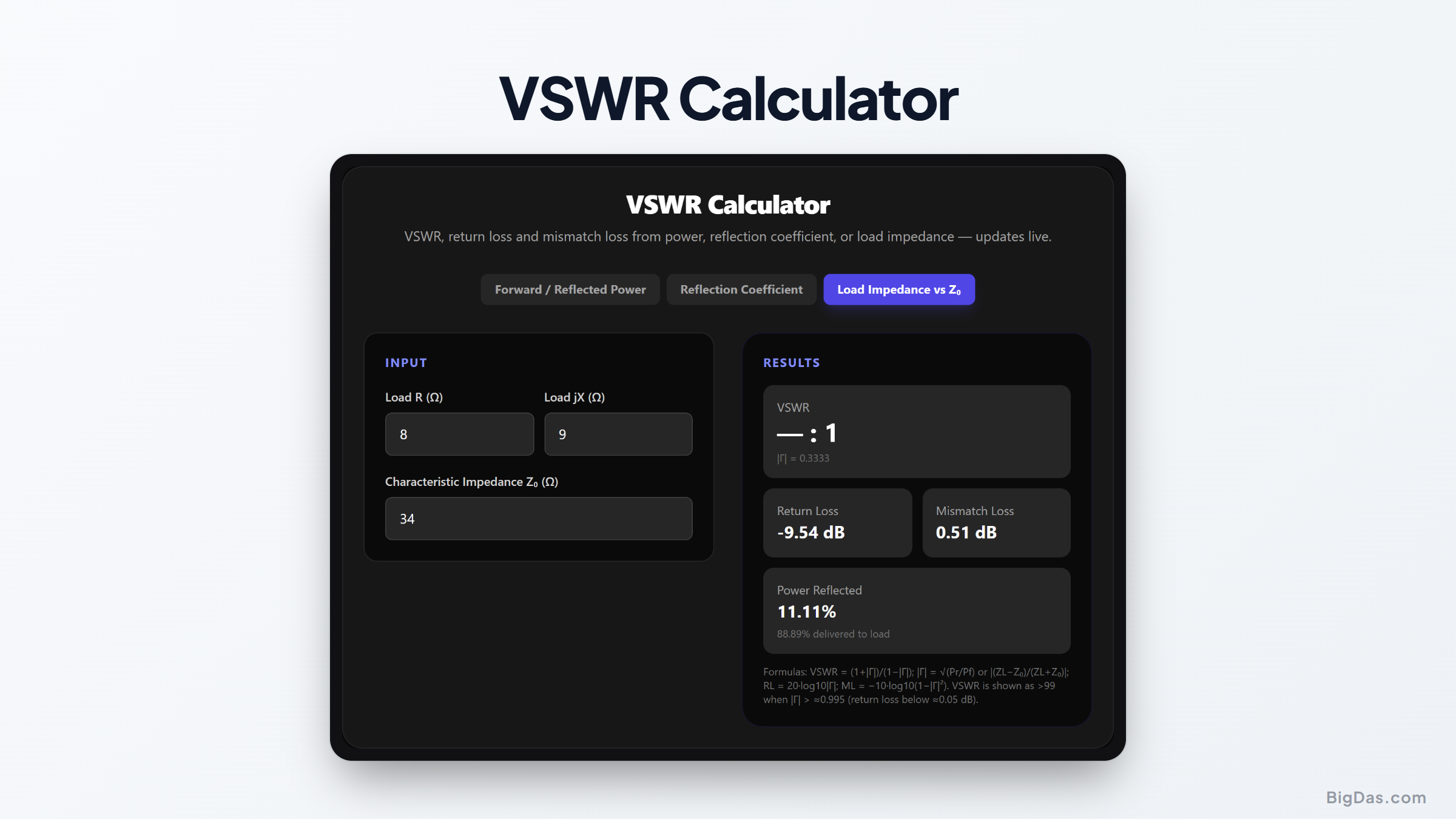
VSWR Calculator
 Generated infographic and interface snapshot for VSWR Calculator
From forward power to standing-wave ratio in one glance.
Free VSWR Calculator Online. Big Das
When RF energy hits a load that doesn't match the transmission line, some of it reflects back. That creates standing waves, which waste power, generate heat, and can damage hardware. The Big Das VSWR Calculator takes forward/reflected power, a reflection coefficient, or a complex load impedance, and returns VSWR, return loss, mismatch loss, and delivered power. It runs entirely in the browser.
What Is VSWR?
VSWR (Voltage Standing Wave Ratio) is the ratio of the maximum voltage to the minimum voltage along a mismatched feed line. A perfectly matched load absorbs all the energy and produces no standing wave: VSWR = 1:1. As the mismatch worsens, the peak-to-valley ratio increases without limit, reaching infinity for a fully reflective open or short circuit.
A number like 1.5:1 doesn't immediately convey how much power is lost, so the calculator also outputs return loss (how much weaker the reflection is than the forward wave, in dB) and mismatch loss (the power that never reaches the load, in dB).
How to Use the VSWR Calculator
- Choose an input mode: Forward / Reflected Power, Reflection Coefficient, or Load Impedance vs Z₀.
- Fill in the fields that appear:
- Forward and reflected power values (same unit; watts or equal-ratio dBm),
- a reflection-coefficient magnitude between 0 and 1, or
- load resistance R, reactance jX (with sign), and characteristic impedance Z₀ of your system (usually 50 Ω or 75 Ω).
- Read the results panel: VSWR, |Γ|, return loss, mismatch loss, reflected vs delivered power, and (in power mode) absolute watts delivered.
The Formulas Used ```
Γ = (ZL − Z0)/(ZL + Z0) (complex, ZL = R + jX) |Γ| = sqrt(Pr / Pf) (from power measurements) VSWR = (1 + |Γ|) / (1 − |Γ|) Return loss RL = 20·log10(|Γ|) (dB, ≤ 0 shown as ∞) Mismatch loss ML = −10·log10(1 − |Γ|²) (dB, ≥ 0) Power delivered Pload = Pf − Pr
VSWR displays as `> 99 : 1` when |Γ| exceeds about 0.995. Beyond that point, return loss is below 0.05 dB, and the exact ratio stops being useful.

---

## Worked Example

Your 100 W transceiver feeds an antenna tuner, and the cross-needle meter reads **4 W** reflected:

- |Γ| = √(4/100) = √0.04 = **0.2**
- VSWR = (1 + 0.2) / (1 − 0.2) = 1.2 / 0.8 = **1.50 : 1**
- Return loss = 20·log10(0.2) = **−13.98 dB** (often quoted as "14 dB return loss")
- Mismatch loss = −10·log10(1 − 0.04) = **0.18 dB**
- Delivered to the load: 96 W (96%)

A 1.5:1 match wastes under 0.2 dB, which is typical for a tuned dipole. By contrast, an open or short with |Γ| = 1 returns the capped `>99 : 1` result.

---

## Common Use Cases

- **Antenna tuning & verification**: translate a reflected-power reading into a concrete VSWR.
- **Amplifier protection**: high-return (low VSWR) loads prevent PA overheating.
- **Filter & matching-network design**: convert complex `R + jX` values from a network analyzer into an SWR target.
- **Lab RF work**: quick numeric sanity checks without a Smith chart.

---

## Frequently Asked Questions

### What is a "good" VSWR?

1:1 is ideal but hard to achieve. Under 1.5:1 is excellent for amateur and test equipment; many commercial radios tolerate 2:1; solid-state PAs usually fold back power beyond 2.5 to 3:1.

### Why does the capped VSWR display use 99:1?

VSWR approaches infinity as the load becomes an open or short circuit. The ratio exceeds 99 whenever |Γ| > 0.995, which is roughly the resolution limit where extra precision no longer affects design decisions.

### Can I enter power in dBm?

Yes, as long as forward and reflected use the same unit. The formula |Γ| = √(Pr/Pf) is ratio-based, so dBm works. Enter raw watts if you also need the absolute delivered-power figure.

### What reactance sign should I use?

Enter positive `jX` for inductive loads and negative for capacitive loads. The sign doesn't change VSWR, but it does rotate Γ on the Smith chart (see the companion Reflection Coefficient Calculator).

### Why is return loss written as a negative?

RL = 20·log10|Γ| is always ≤ 0, so −14 dB means the reflected wave is 14 dB weaker than the incident wave. Datasheets often drop the sign and quote "14 dB" instead.

### Does the impedance mode assume a resistive Z₀?

Yes, the standard case of 50 Ω or 75 Ω coax. The calculator checks that Z₀ is positive and that the denominator ZL + Z₀ isn't effectively zero, which would cause Γ to blow up.