Roman Numeral Converter
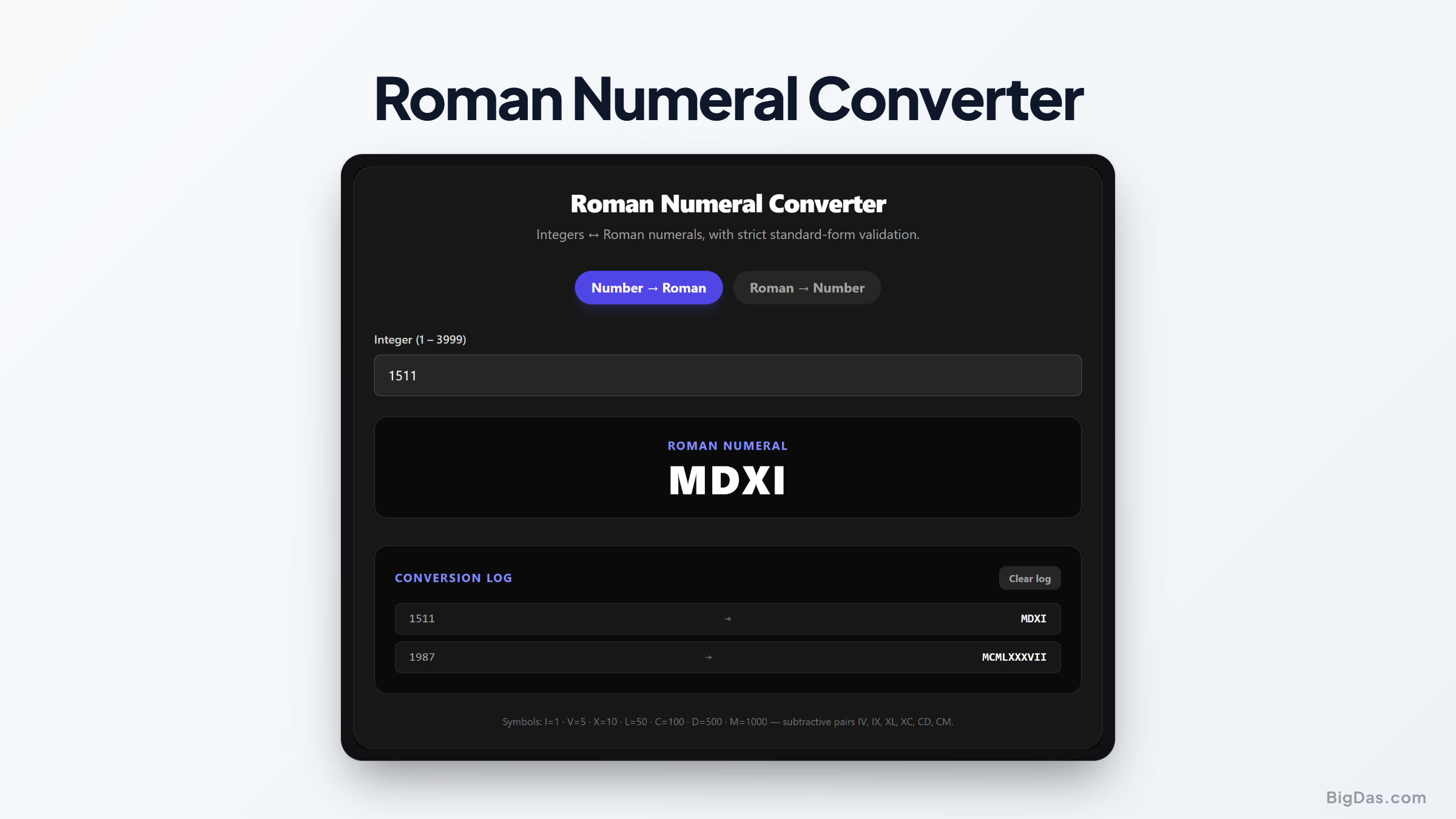
 Generated infographic and interface snapshot for Roman Numeral Converter
Roman Numeral Converter: Translate Integers and Symbols Accurately
The Roman numeral system remains a fascinating part of our historical and cultural landscape. While we rely on Arabic numerals for modern commerce and mathematics, Roman numerals persist in clocks, cornerstones, movie credits, and academic outlines. Despite their presence, translating between these two systems can feel confusing because the rules for Roman numerals do not follow the familiar positional logic of our standard base 10 system. Whether you are dealing with complex dates or specific stylistic requirements, manual conversion often leads to errors. A dedicated Roman numeral converter provides the precision needed to handle these tasks instantly.
What is a Roman Numeral Converter?
A Roman numeral converter is a digital utility designed to bridge the gap between two distinct numerical languages. It translates standard integers like 1999 into their Roman equivalent, MCMXCIX, and conversely, it interprets strings of Roman characters back into Arabic numbers.
The tool operates on the strict standard form of Roman notation. This ensures that the output adheres to the historical and stylistic conventions used by scholars and historians. By automating the application of additive and subtractive rules, the converter removes the guesswork from translating symbols. It validates input to ensure that the notation is authentic, preventing common mistakes that occur when people attempt to create symbols that do not exist within the formal system.
Key Features and Benefits
Accuracy is the primary benefit of using this tool. Roman numerals depend on specific placement rules. For instance, the placement of symbols like IV, XL, or CD determines whether a value is added or subtracted. A manual calculation can easily go wrong if you lose track of the subtractive pairs.
Another advantage is the speed of translation. Converting a large number like 3888 into MMMDCCCLXXXVIII takes significant time and focus. The tool processes these requests in a fraction of a second, which is essential for projects involving lists or chronological sequencing.
The converter also acts as an educational aid. It enforces the rules of standard notation, which helps users learn how the system functions. By seeing the translation happen in real time, you gain a better understanding of why certain symbols appear in specific orders. This is particularly helpful for those working on creative projects, architectural designs, or historical research where stylistic consistency is vital.
Step by Step Guide on How to Use It
Using the converter is a straightforward process designed to minimize friction. You do not need technical knowledge to produce accurate results.
First, identify the direction of your conversion. Most tools feature two distinct input fields. If you need a number to roman conversion, type your Arabic integer into the designated area. If you possess a string of symbols and need to find the numerical value, use the roman to number field.
Second, enter your data. Ensure that you are using standard characters. When typing Roman numerals, you can use either uppercase or lowercase letters, as the tool is built to normalize the input.
Third, execute the conversion. Once you press the button or trigger the input, the tool validates the string. If the Roman numeral is invalid, such as a sequence that violates the additive rules, the tool will alert you to the error. This validation layer is critical for ensuring that your final output is grammatically correct within the context of the Roman system.
Finally, copy the result. Most tools provide a simple button to copy the output to your clipboard, allowing you to paste it directly into your document, design software, or presentation.
Why You Need This Tool
There are several scenarios where this tool proves its worth. Historians and writers often encounter dates on monuments or title pages that must be converted into a readable format for their readers. Without a reliable tool, translating these dates requires a reference chart and careful arithmetic, which is prone to human error.
Graphic designers and artists frequently use Roman numerals for aesthetic purposes. When designing a logo, a watch face, or a chapter header, you must ensure that the symbols are correct. A single incorrect character can ruin the professional appearance of a design. Using a converter ensures that your symbols are technically perfect.
Educators also find this tool useful for creating quizzes or study materials. It allows them to generate accurate examples for students who are learning the logic behind the system. By verifying their own work against the tool, students can build confidence in their ability to recognize and translate these symbols independently.
Furthermore, legal and academic documents sometimes require the use of Roman numerals for section numbering. Maintaining a consistent format throughout a long document is easier when you have a reliable way to translate your headers.
FAQ Section
Is there a zero in the Roman numeral system?
No, the traditional Roman system does not have a symbol for zero. The concept of zero was not part of the Roman mathematical framework. If you attempt to convert zero, the tool will indicate that no valid Roman numeral exists for this value.
Can I convert any number into a Roman numeral?
Standard Roman numerals are effective for numbers up to 3999. While there are historical extensions for larger numbers using bars over letters to indicate multiplication, the standard converter focuses on the common notation used in modern context. Most tools will limit input to the range of 1 to 3999.
What happens if I type an invalid sequence?
The tool includes a validation engine. If you enter a sequence that violates standard form, such as putting four identical characters in a row or using an incorrect subtractive pair, the tool will display an error message. This feature prevents you from accidentally using incorrect or non standard notation in your work.
Does capitalization matter?
The tool is designed to be flexible. Whether you input characters in uppercase or lowercase, the system interprets them correctly. However, the output is typically displayed in uppercase to align with standard publishing and design practices.
Why do some Roman numerals use subtraction?
Subtraction is used to avoid repeating the same symbol more than three times. For example, instead of writing IIII for four, the system uses IV, which represents one subtracted from five. This keeps the notation concise and readable.
Final Perspective on Roman Numeral Conversion
The Roman numeral system possesses a unique elegance that continues to influence modern aesthetics. While it may seem rigid, the rules governing its structure serve a clear purpose in maintaining clarity and consistency. By utilizing a dedicated Roman numeral converter, you ensure that your translations are accurate and adhere to historical standards. This approach removes the burden of manual calculation and minimizes the risk of errors in your professional or creative work.
The value of this tool lies in its ability to handle the complexity of the conversion process behind the scenes. Whether you are translating complex dates or simply formatting a list for a publication, the converter provides a reliable way to manage these symbols. By relying on a tool that enforces standard form, you maintain the integrity of your content while benefiting from the speed of modern technology. As you continue to work with these classical symbols, keeping a reliable conversion method nearby will ensure that your output remains clear, professional, and correct every time.