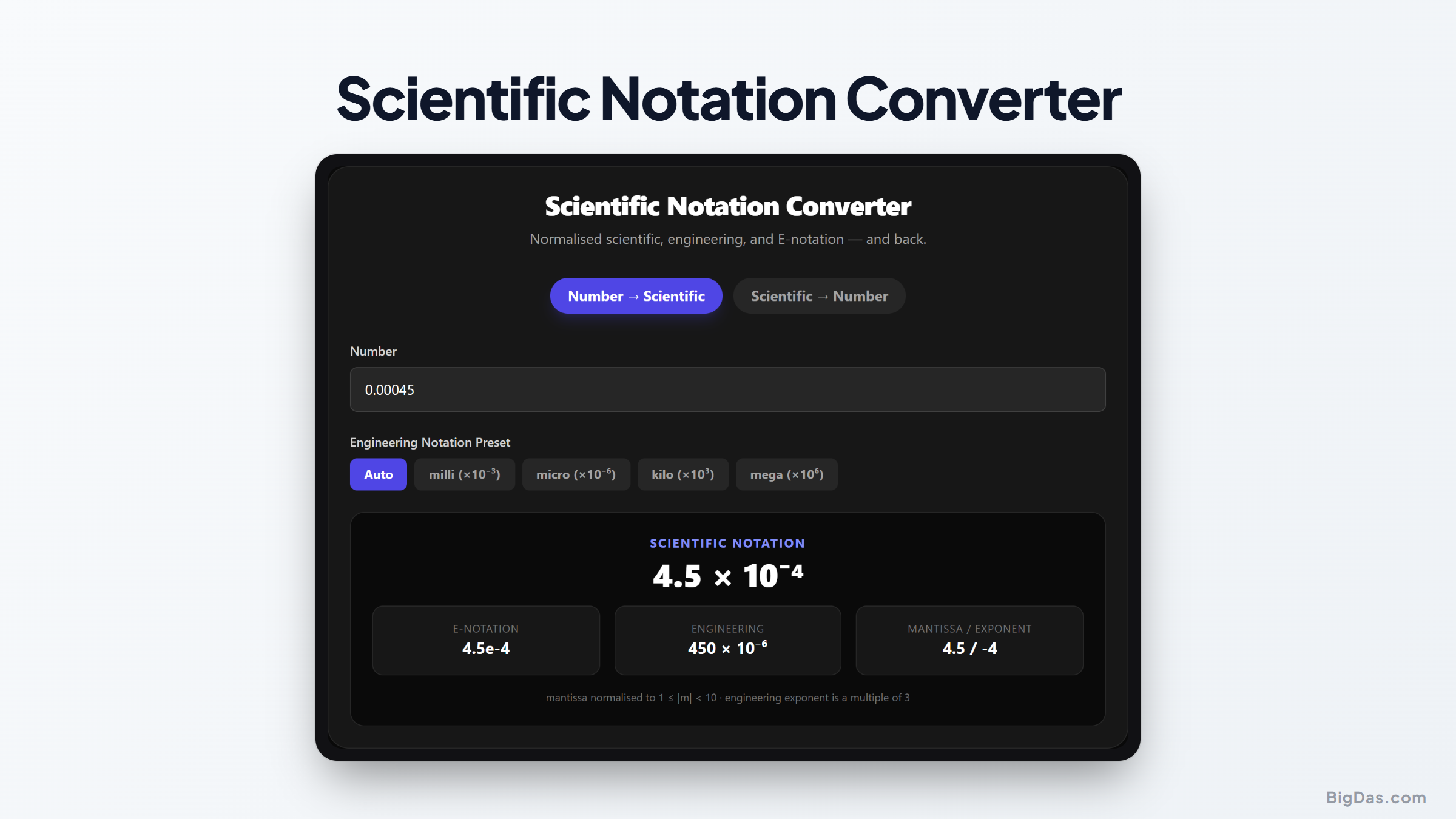
Scientific Notation Converter
 Generated infographic and interface snapshot for Scientific Notation Converter
Scientific Notation Converter: A Simple Guide to Handling Large and Small Numbers
Dealing with numbers that are either astronomically large or infinitesimally small can be a source of frustration for students, engineers, and scientists alike. When you are staring at a string of zeros or trying to manage complex equations, the risk of making a simple transcription error increases. This is where a reliable scientific notation converter becomes an essential part of your digital toolkit. By automating the process of shifting decimal points and managing exponents, you ensure accuracy while saving time on repetitive calculations.
What is Scientific Notation Converter?
A scientific notation converter is a specialized digital tool designed to translate numbers between different mathematical formats. Whether you are looking at a standard decimal number like 0.000000005, or you are trying to interpret a value written as 5 × 10^-9, this tool bridges the gap.
It supports several common formats, including normalized scientific notation, engineering notation, and E notation. At its core, the tool performs the heavy lifting of adjusting the mantissa and the exponent to match your specific output requirements. It removes the ambiguity from representing data, allowing you to focus on the results of your work rather than the mechanics of formatting.
Key Features and Benefits
The primary advantage of using a dedicated converter is precision. Manual conversion requires careful attention to the placement of the decimal point and the counting of digits. A small slip in counting zeros can lead to significant errors in technical reports or classroom assignments. Our converter eliminates this manual risk by using precise algorithms to handle every digit.
Another feature is the support for multiple notation styles. While standard scientific notation always keeps a single non zero digit before the decimal point, engineering notation follows a different rule. It uses powers of ten that are multiples of three, such as 10^3, 10^6, or 10^-9. This aligns with standard SI prefixes like kilo, mega, or nano. Being able to toggle between these formats instantly makes the tool versatile for various fields, from electrical engineering to theoretical physics.
The tool also handles E notation, which is the standard format for calculators and programming languages. If you have ever seen a number displayed as 1.25E+10 on your calculator screen, you are looking at E notation. The converter allows you to translate these machine readable strings into human readable standard form or engineering notation without needing to manually interpret the E character.
Step by Step Guide on How to Use It
Using the scientific notation converter is a straightforward process. You do not need technical expertise to achieve accurate results. Follow these instructions to get the most out of the tool:
First, identify the number you need to convert and choose the format you currently have. Enter the value into the primary input field. If you are working with scientific notation, you will typically enter the mantissa followed by the exponent.
Second, select your desired output format from the provided options. You can choose between normal decimal notation, normalized scientific notation, engineering notation, or E notation.
Third, execute the conversion. The tool will process your input and display the result immediately. You can copy this result for use in other documents, spreadsheets, or software applications.
If you are unsure about the formatting of your input, most versions of this tool allow for flexible entry. You can input large integers, standard decimals, or existing exponential forms, and the tool will normalize them according to your chosen settings. This flexibility ensures that you can move from a raw data set to a formatted report with minimal effort.
Why You Need This Tool
There are many scenarios where this tool becomes indispensable. Consider the following use cases:
Simplifying Academic Assignments
Students often deal with chemistry or physics problems where values range from the mass of an electron to the distance between galaxies. Writing out sixteen zeros on a page is not only tedious but also prone to error. Using a standard form calculator allows students to verify their work quickly and ensures that their final answers are formatted correctly according to their instructor requirements.
Engineering and Technical Reporting
Engineers must frequently convert units to align with prefixes such as micro, milli, or giga. Since these prefixes correspond to specific powers of ten, using engineering notation is mandatory for clear communication. An engineering notation converter helps engineers format their technical specifications in a way that is easily understood by peers and clients.
Programming and Data Entry
Software developers and data analysts often deal with E notation when working with floating point numbers in databases. If a system outputs a result in E notation, but a report requires standard decimal format, the converter provides a fast way to bridge that gap. This ensures consistency across different software interfaces and makes data validation much easier.
Research and Laboratory Analysis
In a laboratory setting, precision is everything. When recording measurements from high sensitivity instruments, data often appears in scientific notation by default. Converting these values into a consistent format allows for better comparison of data sets, preventing the confusion that arises when comparing values represented in different powers of ten.
Understanding the Components
To master these conversions, it helps to understand the two main components of scientific notation: the mantissa and the exponent. The mantissa is the significant part of the number, which is usually a decimal value between one and ten. The exponent is the power of ten that indicates how many places the decimal point has been shifted.
When you use a standard form calculator, you are essentially manipulating these two parts. If you shift the decimal point to the left, you increase the exponent. If you shift it to the right, you decrease the exponent. The converter manages this movement automatically, ensuring that the total value of the number remains unchanged throughout the process.
FAQ Section
What is the difference between scientific and engineering notation?
The main difference lies in the exponent. Scientific notation uses any integer as an exponent, while engineering notation requires the exponent to be a multiple of three. This makes engineering notation more convenient for working with SI unit prefixes.
Can this tool handle negative exponents?
Yes. Negative exponents represent very small numbers, such as 0.0001. The converter handles these as easily as it handles large numbers with positive exponents.
Is the result always rounded?
The converter aims to maintain the precision of your input. If your input has a specific number of decimal places, the tool will aim to reflect that in the output. For extremely long numbers, there may be a limit on the displayed digits, but the conversion logic remains exact.
Why does my calculator use E notation?
E notation is a compact way to display very large or very small numbers on small screens. It replaces the phrase multiplied by ten to the power of with the letter E, which saves space and simplifies the display for electronic hardware.
Can I convert from E notation to standard decimal form?
Absolutely. You can enter a value like 4.5E+06 into the tool, and it will output 4,500,000. This is one of the most common ways this tool is used to make machine data readable for humans.
Understanding the Value of Clarity
Mathematical notation is a language of its own. Just as you would use a dictionary to translate a foreign language, you use a scientific notation converter to translate between different ways of expressing magnitude. The goal is always clarity and precision. By using this tool, you remove the guesswork from your work. You ensure that your reports, your homework, and your data logs are consistent, accurate, and professional.
Whether you are working with the vast scales of space or the microscopic scales of atoms, the rules of exponents remain the same. The converter simply acts as a reliable partner in your calculations. It frees your mind from the mundane task of counting decimal places, allowing you to devote more energy to the actual problem at hand. As you integrate this tool into your workflow, you will find that managing complex numbers becomes a seamless part of your daily routine rather than a persistent hurdle.