Word Frequency & Keyword Density Analyzer
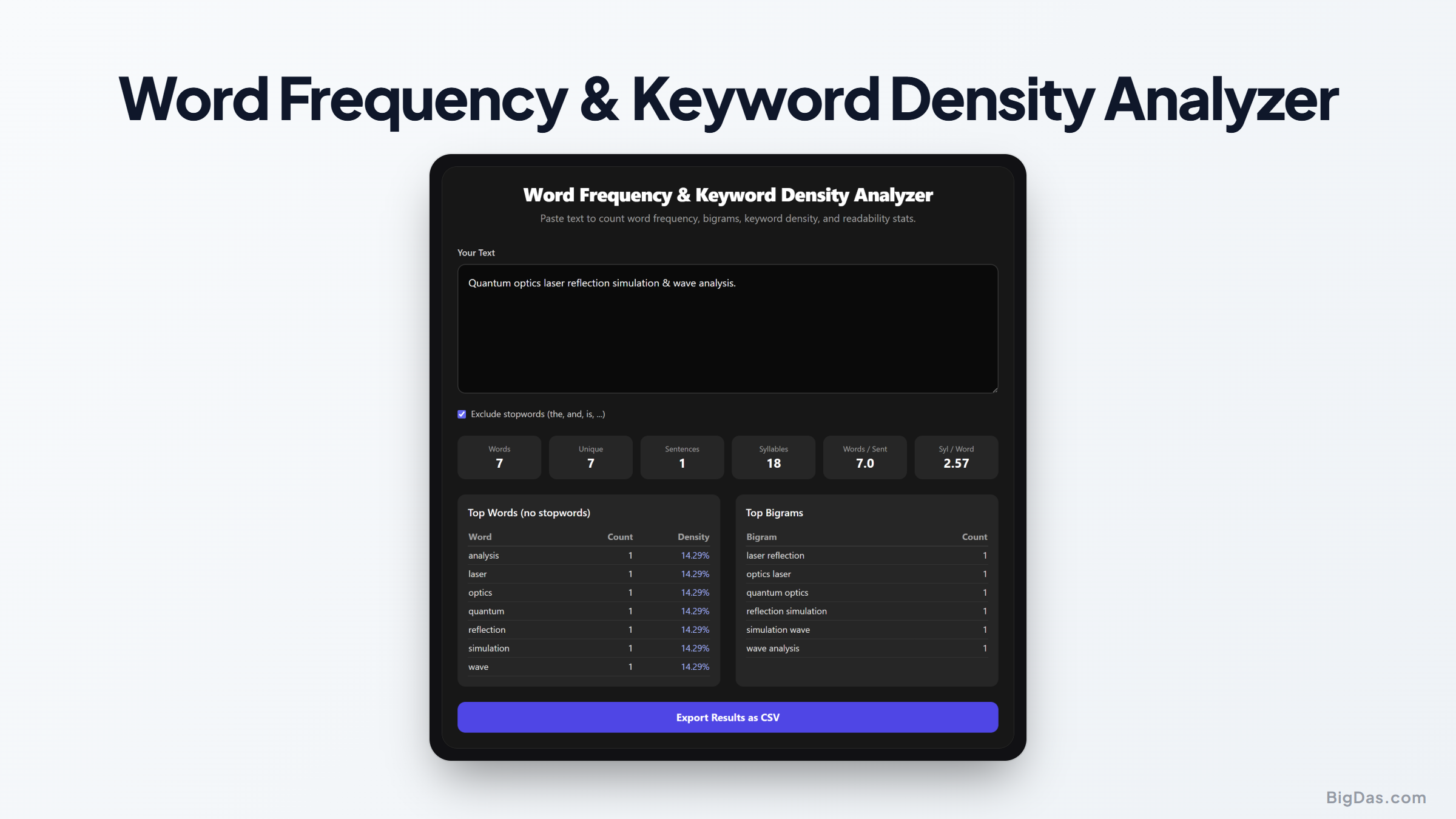
 Generated infographic and interface snapshot for Word Frequency & Keyword Density Analyzer
Mastering Content Optimization: A Guide to Word Frequency and Keyword Density Analysis
Writing for the web involves a delicate balance between catering to search engine algorithms and maintaining human readability. Content creators often struggle to understand how their writing patterns influence search engine rankings. While the core of great content is quality, the structure of your language plays a functional role in how that content is indexed and interpreted. Using a dedicated word frequency and keyword density analyzer allows you to peek behind the curtain of your own writing.
By evaluating the repetition of specific terms, identifying common phrases, and measuring the complexity of your prose, you can refine your drafts to be more effective. This process is not about gaming a system but about ensuring your primary topics are clear and your delivery is accessible to your target audience.
What is a Word Frequency and Keyword Density Analyzer?
A word frequency and keyword density analyzer is a specialized digital tool designed to parse written text into granular data points. At its simplest, it counts every word in your document and calculates how often each one appears. This provides a raw list of the vocabulary that dominates your content.
Keyword density takes this a step further by calculating the percentage of time a specific term appears in relation to the total word count. This metric helps writers identify if they are overusing certain terms, which could lead to search engine penalties, or underusing them, which might prevent the text from being associated with a specific topic.
Beyond single words, advanced tools analyze bigrams, which are sequences of two consecutive words. This is vital because language relies on context. A standalone word like "data" is vague, but the bigram "data analysis" provides specific meaning. By looking at these groupings, you get a much clearer picture of the actual subject matter being presented in your text.
Key Features and Benefits
Effective content optimization relies on actionable data. This tool provides several core metrics that help you polish your writing.
Precise Word Counting
While many word processors include a basic count, this tool breaks down the distribution of words. It identifies which terms appear most frequently, allowing you to see if your writing reflects your intended focus. If you are writing about gardening but find that the word "plants" appears only once while "tools" appears twenty times, you know your focus is skewed.
Bigram Frequency Analysis
Bigrams are the building blocks of search queries. Most people search using phrases rather than single words. Analyzing these pairs helps you ensure that your content naturally incorporates the phrases your audience is searching for. It also highlights repetitive phrasing that might make your writing feel stagnant.
Keyword Density Calculation
The density of your primary keywords is a balance. If the density is too low, search engines may struggle to categorize the page. If it is too high, the text may appear unnatural or spammy to both readers and automated systems. This tool provides the exact percentage, helping you maintain a natural flow while keeping your core topics prominent.
Readability Statistics
Writing for the web requires clarity. Readability metrics assess the structure of your sentences and the complexity of your vocabulary. By understanding these statistics, you can adjust your sentence length and word choice to match the expected level of your audience, ensuring your message remains accessible.
Efficient Data Export
Analyzing your text is only half the battle. The ability to export your results into a CSV file allows you to track your progress over time, share findings with editors, or integrate your data into spreadsheets for deeper manual review. This is particularly useful for teams managing large content libraries.
Step by Step Guide on How to Use It
Using this tool requires no technical expertise. You can optimize your content by following this straightforward process.
First, copy the text you want to analyze from your document editor. Paste the text directly into the input field on the tool interface. Once the text is placed, the tool will automatically process the data.
Second, review the frequency list. Look at the top ten words. Do these terms align with the topic you want to rank for? If not, consider editing your text to include more relevant terminology. Check the bigram list to see if your key phrases are appearing in a natural context.
Third, verify the keyword density. Most experts recommend keeping your primary keyword density within a reasonable range, typically between one and three percent. If your density is significantly higher, look for places where you can swap out the term for synonyms to improve the quality of your prose.
Fourth, examine the readability statistics. If the score indicates the text is difficult to read, break long sentences into smaller, distinct thoughts. Use the export button to save your findings as a CSV file if you need to keep a record of your changes or compare versions of your article.
Why You Need This Tool
There are many scenarios where manual editing is insufficient for effective content management.
For search engine optimization professionals, this tool is essential for auditing existing pages. You can quickly determine if a page is failing to rank because the content is too thin on relevant keywords or because the keyword usage is inconsistent. It acts as a diagnostic layer that identifies structural weaknesses in your writing.
For bloggers and content writers, this tool serves as a final quality check before publication. It helps catch accidental repetitions or phrases that are unintentionally prominent. If you find yourself using a specific filler word too often, the frequency list will highlight it immediately, allowing you to clean up your style.
For students and academics, this tool can help in checking the distribution of terminology in a thesis or report. It ensures that the primary concepts of the research are sufficiently covered and that the writing remains clear and concise.
Finally, for copywriters working with strict length constraints, the tool provides an immediate overview of content density. It ensures that every word serves a purpose and that the most important messages are the most visible within the text.
FAQ Section
Does keyword density still matter for search rankings?
Yes, but not in the way it did years ago. Modern search engines prioritize content relevance and context over exact keyword counts. However, maintaining a clear density of relevant terms helps search engines understand the topic of your page.
What is the ideal keyword density?
There is no fixed number. The best approach is to write naturally for a human reader. If you focus on providing value and covering your topic comprehensively, your keyword density will typically fall into a natural, acceptable range.
Why do I need to analyze bigrams?
Bigrams provide context. Since search queries are usually multi-word phrases, analyzing these pairs helps you align your content with the way people actually search for information online.
Can this tool improve my writing style?
While the tool primarily focuses on data, the readability statistics and frequency lists can indirectly improve your style. By identifying repetitive words and complex sentence structures, you are encouraged to simplify your language and diversify your vocabulary.
Final Observations
Content optimization is an ongoing process of refining how you communicate information. By using a word frequency and keyword density analyzer, you gain objective insights into the structure and focus of your text. These tools do not replace the need for thoughtful writing, but they provide a foundation for making informed decisions about how your content is constructed.
Whether you are auditing a long form article, checking a product description, or refining a blog post, the data provided by this tool helps you ensure that your message is clear, your topics are well represented, and your writing is accessible to your audience. Consistent use of such tools helps you maintain a standard of quality that supports both the human reader and the technical requirements of the web. As you continue to produce content, keep these metrics in mind to build a more effective and engaging library of work.