Unveiling Global Peace: Understanding the Global Peace Index 2024 for Safety, Conflict, and Data-Driven Insights

Global Peace Index 2024

Global Peace Index 2024 Header Image

Unveiling Global Peace: Understanding the Global Peace Index 2024 for Safety, Conflict, and Data-Driven Insights

In a world perpetually grappling with headlines of strife, instability, and humanitarian crises, the concept of peace often feels elusive, a lofty ideal rather than a measurable reality. Yet, for over a decade and a half, the Global Peace Index (GPI) has provided an indispensable framework for understanding, measuring, and tracking the state of peace across the globe. As we look to the present and future, the Global Peace Index 2024 emerges as an even more critical resource, offering comprehensive data and profound insights into the most and least peaceful countries worldwide.

This meticulously compiled report transcends mere rankings; it's a diagnostic tool, a historical record, and a predictive indicator, all rolled into one. For anyone deeply invested in understanding the dynamics of global peace, the root causes of conflict, the nuances of national safety, or simply appreciating how data is beautiful when applied to complex human phenomena, the GPI 2024 is an unparalleled guide.

This extensive guide will delve into what the Global Peace Index 2024 is, its groundbreaking features, how you can leverage its power, and why it is an absolutely essential tool for a diverse range of professionals, policymakers, researchers, and engaged citizens.

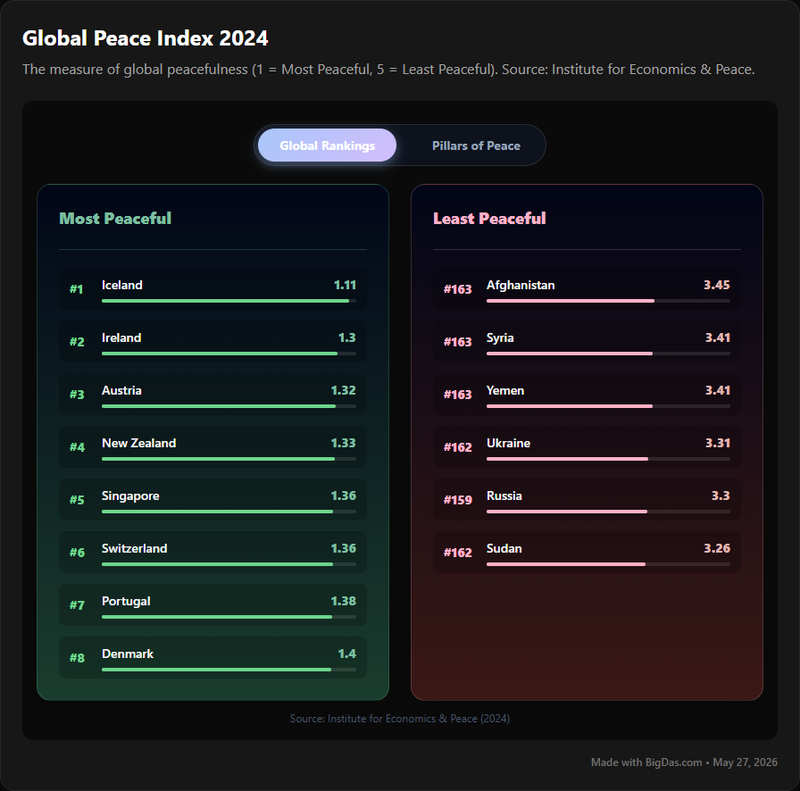
Global Peace Index 2024 Chart

What is the Global Peace Index 2024?

The Global Peace Index is the world’s leading measure of global peacefulness. Produced by the Institute for Economics & Peace (IEP), an independent, non-partisan, non-profit think tank dedicated to shifting the world's focus to peace as a positive, achievable, and tangible measure of human well-being and progress, the GPI offers a data-driven analysis of peace trends. The GPI 2024 marks the latest iteration of this groundbreaking series, continuing its legacy of providing a holistic perspective on the state of global peace.

At its core, the GPI 2024 ranks 163 independent states and territories — covering over 99.7 percent of the world’s population — according to their levels of peacefulness. It’s not just about the absence of war; the index employs a sophisticated, multi-faceted methodology to assess both the internal and external peacefulness of nations. This comprehensive approach ensures that the rankings reflect a nuanced reality, acknowledging that peace is a product of many interconnected factors.

The methodology of the GPI is built around 23 qualitative and quantitative indicators, grouped into three broad domains:

  1. Societal Safety and Security: This domain assesses the levels of harmony or discord within a nation. Indicators include measures of violent crime, political instability, terrorism impact, perceptions of criminality, and internal conflict. A country with low levels of internal conflict and high social cohesion will score well here, signifying a strong foundation for internal safety.
  2. Ongoing Domestic and International Conflict: This domain quantifies a country's involvement in both internal and external conflicts. It considers the number and duration of internal conflicts, relations with neighboring countries, the number of deaths from organized conflict, and the intensity of organized internal conflict. This section directly addresses the traditional understanding of conflict and its human cost.
  3. Militarisation: This domain explores a country's military expenditure as a percentage of GDP, its number of armed services personnel per 100,000 people, its imports and exports of major conventional weapons, and its nuclear and heavy weapons capabilities. High levels of militarisation often correlate with a lower score in peacefulness, reflecting a reliance on military solutions rather than diplomatic ones.

Each indicator is meticulously scored, and these scores are then aggregated to produce a single, composite score for each country. A lower score on the GPI indicates a higher level of peacefulness. This rigorous, data-driven methodology is what lends the GPI 2024 its unparalleled authority and makes it an indispensable reference point for anyone interested in global peace and safety.

Key Features & Benefits of the Global Peace Index 2024

The Global Peace Index 2024 is more than just a report; it's a powerful analytical tool packed with features designed to provide deep insights and actionable intelligence. Its benefits extend across a wide spectrum of users, from policy experts to everyday citizens.

Key Features:

  • Comprehensive Global Ranking: The GPI 2024 ranks 163 nations, offering a complete snapshot of the world's most and least peaceful countries. This year's index provides an updated list of top-performing nations, as well as those facing significant challenges, allowing for immediate comparisons and trend identification.
  • Multi-Domain Analysis: Unlike simpler metrics, the GPI breaks down peacefulness into three distinct but interconnected domains: Societal Safety and Security, Ongoing Domestic and International Conflict, and Militarisation. This granular analysis allows users to understand why a country ranks where it does and to pinpoint specific areas of strength or weakness.
  • Detailed Indicator Data: Beyond overall scores, the report provides data for each of the 23 indicators, offering transparency and enabling users to conduct their own in-depth research. This level of detail is crucial for academic studies and policy development.
  • Interactive Data Visualization & Mapping (Data is Beautiful): The IEP website often complements the report with dynamic, interactive maps and data visualization tools. These features transform complex datasets into easily digestible, visually appealing graphics, making it simple to explore trends, compare countries, and understand regional patterns. This truly exemplifies how data is beautiful when presented effectively.
  • Historical Trend Analysis: The GPI isn't a one-off assessment. It provides historical data stretching back to 2007, allowing users to track changes in peacefulness over time for individual countries, regions, and the world as a whole. This longitudinal perspective is vital for identifying long-term patterns and the impact of specific events or policies.
  • In-Depth Regional and Thematic Analysis: The report goes beyond country rankings, offering detailed analysis of regional trends, the economic impact of violence, and specific thematic deep dives into critical issues affecting global peace, such as climate change, geopolitical rivalries, or refugee flows.
  • Economic Impact of Violence Metrics: A unique feature of the GPI is its calculation of the economic cost of violence, providing a stark reminder of the financial burden that conflict and instability place on global and national economies.

Benefits:

  • Informed Decision-Making: For policymakers, government officials, and international organizations, the GPI 2024 offers data-driven insights to inform foreign policy, allocate aid, and design peacebuilding initiatives more effectively.
  • Enhanced Risk Assessment: Businesses, investors, and insurance companies can leverage the GPI data to assess political stability, security risks, and potential market volatility in different regions, informing investment strategies and operational decisions.
  • Empowered Advocacy and Awareness: NGOs, humanitarian organizations, and peace advocates can use the GPI's authoritative data to strengthen their campaigns, raise awareness, and lobby for policies that promote peace and reduce conflict.
  • Valuable Educational Resource: Students and academics in fields like international relations, political science, peace studies, and sociology find the GPI 2024 an invaluable resource for research, dissertations, and classroom discussions. It simplifies complex geopolitical realities into an accessible format.
  • Improved Travel and Personal Safety Planning: Individuals planning international travel can consult the GPI to gain a better understanding of the relative safety and stability of their desired destinations, though it should be used in conjunction with official travel advisories.
  • Global Benchmarking and Accountability: The index allows nations to benchmark their progress against others and provides a mechanism for holding governments accountable for their peace and safety records.
  • Promotes Data Literacy: By presenting complex geopolitical data in an accessible and visual format, the GPI encourages a broader understanding of how data can illuminate critical global issues, reinforcing the idea that data is beautiful and powerful.

Step-by-Step Guide on How to Use the Global Peace Index 2024

Navigating the Global Peace Index 2024 report and its associated online resources can unlock a wealth of information. Here’s a guide to effectively utilizing this powerful tool:

Step 1: Accessing the Report and Resources

  • Official Source: Always start by visiting the official website of the Institute for Economics & Peace (IEP) at economicsandpeace.org. This is where the latest GPI 2024 report, along with supplementary materials and interactive tools, will be published.
  • Download the Full Report: Locate and download the full PDF report. This is your primary document containing detailed analysis, methodology, and country-specific insights.
  • Explore Interactive Tools: Look for interactive maps, data explorers, and country profile pages on the IEP website. These online tools often provide a more dynamic way to engage with the data.

Step 2: Understanding the Structure and Methodology

  • Read the Executive Summary: Start with the executive summary for a high-level overview of the key findings, global trends, and major changes in peacefulness.
  • Dive into the Methodology Section: Before interpreting specific country rankings, thoroughly read the methodology section. This will explain the three domains (Societal Safety and Security, Ongoing Domestic and International Conflict, Militarisation), the 23 indicators, how scores are calculated, and what a lower score signifies (more peaceful). Understanding this is crucial for accurate interpretation.
  • Grasp the Scoring System: Remember, a lower GPI score indicates higher peacefulness. The scores typically range from 1 to 5, with 1 being the most peaceful.

Step 3: Interpreting Global and Regional Trends

  • Overall Global Picture: The report will provide an overview of whether global peacefulness has increased or decreased, and identify the main drivers behind these changes. Pay attention to the global average score.
  • Regional Breakdowns: Explore the sections dedicated to regional analysis. These chapters offer insights into specific continents or geopolitical areas, highlighting unique challenges and progress. For example, understanding why Europe consistently ranks as the most peaceful region or what factors contribute to high conflict in certain parts of the Middle East and Africa.
  • Identify Key Drivers: The report often discusses macro-trends impacting peace, such as terrorism, political instability, economic inequality, or climate change. Understand these overarching themes to put individual country data into context.

Step 4: Analyzing Country-Specific Data

  • Top and Bottom Rankings: Begin by identifying the most peaceful countries and the least peaceful countries. These benchmarks provide context for all other rankings.
  • Individual Country Profiles: Navigate to the sections or interactive tools that allow you to view specific country profiles. Here you can see:
    • The country's overall GPI score and rank.
    • Its scores across the three domains.
    • Performance on each of the 23 individual indicators.
    • Historical trends for that country over several years.
    • Visualizations (charts, graphs) that make the data clear (data is beautiful).
  • Compare and Contrast: Use the data to compare countries of interest. How does one nation’s safety and conflict profile differ from another in the same region or with similar economic conditions?

Step 5: Leveraging the Data for Your Needs

  • For Research: Extract specific data points, trends, and analytical conclusions for academic papers, policy briefs, or presentations. Cite the GPI 2024 as your authoritative source.
  • For Advocacy: Use the stark realities presented by the GPI to strengthen arguments for peacebuilding, humanitarian aid, or policy changes. Highlight the economic impact of violence to underscore urgency.
  • For Decision-Making: Integrate GPI findings into risk assessments for business expansion, investment decisions, or travel advisories. Consider the safety implications.
  • For Education: Incorporate the GPI into curricula to help students understand global dynamics, conflict resolution, and the importance of peace initiatives.

By following these steps, you can move beyond a superficial understanding of the Global Peace Index 2024 and truly harness its power for deep insight and informed action.

Why You Need This Tool (Use Cases)

The Global Peace Index 2024 is not just another academic report; it's a vital, actionable resource across a multitude of sectors and for various stakeholders. Its utility spans from high-level policy formulation to individual awareness.

1. For Policymakers, Governments, and International Relations Professionals:

  • Informing Foreign Policy: Governments can use the GPI 2024 to understand the safety and conflict landscapes of different nations, guiding diplomatic efforts, alliance formations, and trade agreements.
  • Targeting Development Aid: International organizations and donor countries can identify areas most in need of peacebuilding initiatives, humanitarian aid, and development assistance, ensuring resources are directed where they can have the greatest impact.
  • National Security Assessments: Defense and intelligence agencies can leverage GPI data to assess geopolitical risks, internal stability of allies or adversaries, and potential flashpoints for conflict.

2. For NGOs, Humanitarian Organizations, and Peacebuilders:

  • Advocacy and Awareness Campaigns: The authoritative data from the GPI provides a robust evidence base for advocacy efforts aimed at promoting peace, reducing conflict, and addressing root causes of violence.
  • Program Design and Implementation: Organizations working on the ground can use the detailed country indicators to design more effective programs for conflict resolution, community development, and fostering societal safety.
  • Fundraising and Grant Applications: Demonstrating the need for specific interventions with credible, globally recognized data like the GPI can significantly strengthen grant proposals and attract funding.

3. For Academics, Researchers, and Students:

  • Empirical Research: The GPI offers a rich dataset for quantitative and qualitative studies on peace and conflict dynamics, the economic impact of violence, and the effectiveness of peacebuilding strategies.
  • Curriculum Development: Educators in peace studies, political science, international relations, and sociology can integrate the GPI 2024 into their curricula to provide students with a current and comprehensive understanding of global peacefulness.
  • Thesis and Dissertation Support: Students can utilize the GPI's historical data and detailed indicators to support their research, analyze trends, and develop insightful conclusions.

4. For Business, Investors, and Risk Management Professionals:

  • Market Entry and Investment Decisions: Businesses considering expanding into new markets or investors looking for stable opportunities can assess the political stability and safety risks of different countries using GPI data.
  • Supply Chain Resilience: Companies can evaluate the geopolitical risks associated with their supply chains, particularly in regions with high conflict scores, to mitigate potential disruptions.
  • Insurance Underwriting: The GPI can inform risk assessments for political risk insurance, travel insurance, and other forms of coverage related to instability and conflict.

5. For Journalists, Media Professionals, and Analysts:

  • Data-Driven Reporting: Journalists can use the GPI 2024 to add depth, authority, and factual basis to their reporting on global events, conflict zones, and the state of international peace.
  • Contextualizing News: The report helps provide crucial context for understanding daily headlines, moving beyond anecdotal evidence to present a broader, data-informed perspective.
  • Visual Storytelling: The visual elements of the GPI (maps, charts – truly embodying how data is beautiful) are excellent resources for creating engaging and informative infographics and multimedia content.

6. For Engaged Citizens and Travelers:

  • Informed Global Awareness: The GPI empowers individuals to develop a more nuanced understanding of global events, moving beyond sensationalized news to a data-backed reality of peace and conflict.
  • Responsible Travel Planning: While not a sole source for travel advice, the GPI can offer a high-level overview of a country's general safety and stability, which can be useful when planning international trips.
  • Supporting Peace Initiatives: By understanding the metrics, individuals can better advocate for and support organizations working towards creating a more peaceful world.

In essence, the Global Peace Index 2024 serves as a universal compass for understanding, navigating, and ultimately contributing to a more peaceful world. Its rigorous methodology and accessible presentation make it an indispensable tool for anyone seeking to make informed decisions about global peace, safety, and conflict.

Frequently Asked Questions about the Global Peace Index 2024

Here are answers to some common questions about the Global Peace Index 2024, designed to provide clarity and deeper understanding:

Q1: What does a country's GPI score actually represent?

A: A country's GPI score is a composite measure derived from 23 indicators across three domains: Societal Safety and Security, Ongoing Domestic and International Conflict, and Militarisation. A lower score indicates a higher level of peacefulness, meaning the country experiences less internal violence, is less involved in conflicts, and has lower levels of militarization. The scoring scale typically ranges from 1 (most peaceful) to 5 (least peaceful).

Q2: Who produces the Global Peace Index, and how often is it updated?

A: The Global Peace Index is produced annually by the Institute for Economics & Peace (IEP), an independent global think tank. It is updated every year, typically with a new report released in June, providing the most current data and trends in global peacefulness. The GPI 2024 is the latest iteration in this ongoing series.

Q3: How are the 23 indicators weighted, and are they all equally important?

A: Not all indicators are weighted equally. The IEP's methodology assigns different weights to indicators based on their perceived importance in contributing to or detracting from peace. For example, indicators related to deaths from internal conflict or political terror are weighted more heavily than others. The full weighting scheme is detailed in the methodology section of the report.

Q4: Can I compare a country's GPI score over time?

A: Yes, absolutely. One of the key strengths of the Global Peace Index is its historical data. The IEP provides data going back to the first report in 2007. This allows users to track a country's progress or deterioration in peacefulness over multiple years, identifying long-term trends and the impact of specific events or policies. This longitudinal analysis is critical for understanding dynamic peace and conflict situations.

Q5: What were the most significant global trends highlighted in previous GPI reports, and what might the GPI 2024 focus on?

A: Previous GPI reports have consistently highlighted a general decline in global peacefulness over the last decade, driven largely by increased conflict in the Middle East and Africa, the rise of terrorism, and increased geopolitical instability. Key trends often include rising refugee numbers, increased intensity of internal conflicts, and the growing economic cost of violence. For the GPI 2024, expect a focus on the enduring impacts of recent global events (such as ongoing regional conflicts, geopolitical realignments, and the continued effects of climate change) on national safety and international stability.

Q6: How does the GPI relate to other indices of development or governance?

A: The GPI often shows strong correlations with other indices measuring aspects like human development, good governance, economic stability, and corruption. Countries with high levels of peace often perform well in these other areas, indicating that peace is not an isolated factor but is deeply intertwined with broader societal well-being and effective governance. The GPI specifically focuses on the absence of violence and fear, providing a distinct but complementary perspective to these other important global metrics.

Q7: Does the GPI account for different cultural interpretations of "peace"?

A: The GPI strives for an objective, data-driven definition of peace based on the absence of violence and fear. While cultural contexts influence how peace is experienced, the 23 indicators are selected for their universal applicability and measurability across diverse societies. The report acknowledges that "positive peace" (the attitudes, institutions, and structures that create and sustain peaceful societies) is also critical, and the IEP explores this through its Positive Peace Index, which complements the GPI's focus on "negative peace" (the absence of violence).

Q8: Where can I find the specific rankings for the most and least peaceful countries in the GPI 2024?

A: The specific rankings for the most peaceful countries and the least peaceful countries will be prominently featured in the Global Peace Index 2024 report itself, usually within the executive summary and detailed country tables. The interactive map and country profile sections on the IEP website are also excellent resources for this data, often providing dynamic filtering and comparison tools that truly showcase how data is beautiful when applied to such important topics.

Conclusion: The Enduring Value of the Global Peace Index 2024

The Global Peace Index 2024 stands as a testament to the power of data in understanding some of humanity's most complex challenges. In a world characterized by rapid change, interconnectedness, and persistent friction, having a robust, data-driven framework for measuring and analyzing peace is not just beneficial—it is essential.

This comprehensive report offers more than just a list of the most peaceful countries and the least peaceful countries. It provides a detailed diagnostic tool that illuminates the root causes of conflict, quantifies the economic burden of violence, and highlights the critical factors contributing to national safety and stability. For policymakers, it offers a compass for navigating geopolitical complexities; for researchers, it provides a rich dataset for deeper inquiry; for humanitarian organizations, it points to areas of greatest need; and for concerned citizens, it fosters a more informed global awareness.

The GPI 2024 reinforces the understanding that peace is not merely the absence of war, but a dynamic state influenced by societal harmony, international relations, and responsible governance. By making intricate global data accessible and visually compelling, it exemplifies how data is beautiful when harnessed for the greater good, enabling us to engage with crucial global issues with clarity and insight. In fostering a clearer understanding of global peacefulness, the Global Peace Index 2024 serves as an indispensable resource for anyone committed to building a more stable, secure, and peaceful future.