Olympic Medal Counts

Olympic Medal Counts: Unveiling the Grand Tapestry of Athletic Achievement, All-Time and Paris 2024
The Olympic Games stand as humanity's grandest spectacle of athletic prowess, a quadrennial celebration where nations converge, and individuals push the boundaries of human potential. Beyond the inspiring stories of victory and defeat, the Olympics are also a rich tapestry woven with medals, records, and historical narratives. For many, tracking the ebb and flow of national performance, understanding historical dominance, and anticipating future triumphs is as captivating as the events themselves. As the world gears up for the excitement of Paris 2024, the desire for accurate, accessible, and insightful medals data reaches a fever pitch.
In an age where information is power, and well-presented data is beautiful, enthusiasts, analysts, and casual viewers alike seek tools that can cut through the noise and deliver clarity. This is precisely where the Olympic Medal Counts tool shines, offering an unparalleled vantage point into the competitive landscape of the Games. Whether you're a historian tracing the footsteps of athletic legends, a fan passionately supporting your home country, or an analyst dissecting competitive trends, this tool is designed to elevate your Olympic experience, providing deep insights into both the historical grandeur and the unfolding drama of Paris 2024.
Join us as we explore how Olympic Medal Counts transforms raw statistics into compelling stories, making the complex world of Olympic performance understandable, engaging, and profoundly insightful.

What is Olympic Medal Counts?
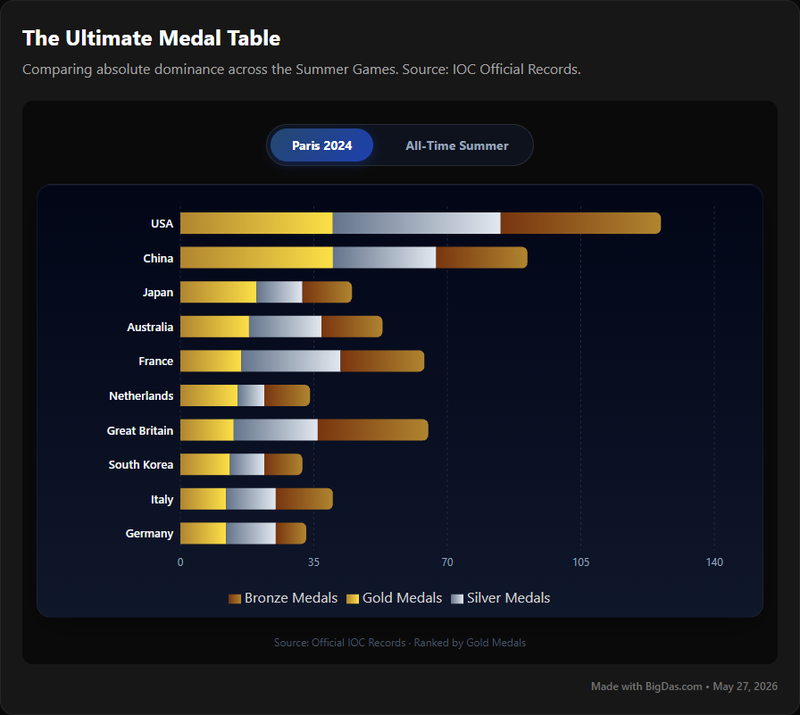
At its core, Olympic Medal Counts is a sophisticated, user-friendly digital platform meticulously designed to track, display, and analyze the medal performances of top countries participating in the Olympic Games. It serves as a comprehensive digital repository, offering two primary, yet interconnected, perspectives:
- All-Time Medal Standings: This section provides a historical overview, allowing users to delve into the cumulative medal counts across all editions of the Summer and Winter Olympic Games. It showcases the enduring legacies of nations, revealing which countries have historically dominated the podium and cemented their place in Olympic lore.
- Paris 2024 Live & Historical Data: With a keen eye on the present and immediate future, this segment focuses specifically on the upcoming Paris 2024 Olympics. During the Games, it offers real-time or near real-time updates on medal tallies, providing a dynamic snapshot of the current competitive landscape. Pre-Games, it might offer projections or historical context for nations participating in Paris.
Far from being a mere list of numbers, Olympic Medal Counts is engineered to transform raw data into actionable insights, helping users understand not just who won, but the broader context of their achievements. It's an indispensable resource for anyone seeking a deeper, data-driven understanding of the Olympics.
Key Features & Benefits
The Olympic Medal Counts tool is packed with features designed to cater to a diverse audience, from casual sports fans to professional statisticians. Each feature is crafted to provide maximum utility and enhance the user's understanding of Olympic performance.
1. Comprehensive All-Time Medal Tables
- Feature: Access to a meticulously compiled database of historical Olympic medal counts, spanning decades of Olympic competition. This includes breakdowns by gold, silver, and bronze, as well as total medals.
- Benefit: Provides an invaluable historical context. Users can easily identify historically dominant nations, track the rise and fall of sporting superpowers, and appreciate the long-term trends in global athletic excellence. It's perfect for educational purposes, historical research, or simply satisfying curiosity about Olympic legacies.
2. Dedicated Paris 2024 Tracking
- Feature: A focused section providing up-to-the-minute or near real-time updates on medal standings specifically for the Paris 2024 Olympics. This includes daily summaries, event-specific medal winners, and aggregated country totals.
- Benefit: Keeps users instantly informed about the current Games. No need to scour multiple sources; all the crucial Paris 2024 medal data is consolidated in one intuitive place, making it easy to follow national progress, cheer for favorite athletes, and stay ahead of the curve.
3. Top Countries Focus
- Feature: The tool intelligently highlights and organizes data for the top-performing countries, both historically and in real-time for Paris 2024. This often includes intuitive visual indicators and clear ranking systems.
- Benefit: Streamlines data consumption. For users primarily interested in the leading contenders and consistent performers, this focus ensures quick access to the most impactful statistics without being overwhelmed by data from smaller nations. It's ideal for quick analysis and competitive overview.
4. Interactive Data Visualization
- Feature: Beyond raw numbers, the tool employs engaging charts, graphs, and interactive elements to visualize medal distribution, historical trends, and country comparisons. This might include interactive maps, bar charts, or line graphs.
- Benefit: Makes complex sports data easily digestible and aesthetically pleasing. The adage "data is beautiful" truly comes alive here, transforming dense statistics into compelling visual narratives. Visualizations aid in identifying patterns, understanding relationships, and absorbing information much faster than reading tables alone.
5. Filter and Sort Functionality
- Feature: Robust filtering and sorting options allow users to customize their view of the medal tables. Sort by Gold, Silver, Bronze, or Total Medals; filter by specific Olympic Games editions (for historical data) or by continent.
- Benefit: Empowers users to drill down into specific areas of interest. Whether you want to see who has the most gold medals regardless of total, or compare performance across specific Summer Games, these features provide flexibility and control over data exploration.
6. Country-Specific Profiles (Potential Feature)
- Feature: (Often included in advanced versions) Detailed profiles for individual countries, showcasing their medal history, top-performing sports, key athletes, and trends over time.
- Benefit: Offers granular insights into national sporting identities. For fans of a particular country, or those conducting in-depth analysis, these profiles provide a complete picture of a nation's Olympic journey and contribution to sports history.
7. Responsive Design & Accessibility
- Feature: Optimized for seamless performance across various devices, from desktops to tablets and smartphones, ensuring a consistent and engaging user experience regardless of how it's accessed.
- Benefit: Provides ultimate convenience. Users can check medal updates on the go, during breaks, or from the comfort of their home, ensuring they never miss a crucial development during Paris 2024 or can revisit historical data anytime, anywhere.
These features collectively position Olympic Medal Counts not just as a data aggregator, but as a powerful analytical engine and an engaging companion for anyone passionate about the Olympics.
Step-by-Step Guide on How to Use Olympic Medal Counts
Navigating the Olympic Medal Counts tool is designed to be intuitive and straightforward, ensuring that even first-time users can quickly access the data they need. Here's a simple guide to getting started and maximizing your experience:
Step 1: Accessing the Tool
- Action: Locate and open the Olympic Medal Counts tool, typically via a web browser on your computer or mobile device.
- Tip: For frequent use, consider bookmarking the page or adding it to your home screen for quick access, especially during Paris 2024.
Step 2: Choosing Your View – All-Time or Paris 2024
- Action: Upon loading, you'll usually be presented with a clear navigation option to choose between "All-Time Medal Counts" and "Paris 2024 Medal Tracker." Click on the view that interests you.
- If you select "All-Time": You'll see a comprehensive historical table of medal counts by country, often sorted by total gold medals.
- If you select "Paris 2024": You'll be directed to the current or projected medal standings for the upcoming Games, dynamically updated during the event.
- Tip: Start with the "Paris 2024" tracker if the Games are ongoing or imminent to get the most current picture. Switch to "All-Time" for historical context.
Step 3: Navigating the Medal Table
- Action: Once you've selected your view, you'll see a table listing countries and their respective medal counts (Gold, Silver, Bronze, Total).
- Columns: Look for clearly labeled columns indicating "Country," "Gold," "Silver," "Bronze," and "Total."
- Rows: Each row represents a country.
- Tip: Familiarize yourself with the layout. The standard Olympic sorting is usually by Gold, then Silver, then Bronze, and finally by Total Medals to break ties.
Step 4: Utilizing Filtering and Sorting Options
- Action: Look for interactive elements, typically at the top of the table or as a sidebar, that allow you to sort and filter the data.
- Sorting: Click on column headers (e.g., "Gold," "Total") to sort the table ascending or descending by that specific medal type.
- Filtering (All-Time): For the "All-Time" view, you might find options to filter by specific Olympic Games editions (e.g., "Summer Olympics," "Winter Olympics," or by year ranges).
- Filtering (Paris 2024): During Paris 2024, you might be able to filter by sports or even view medal counts for specific days.
- Example: To see which country has the most silver medals all-time, select "All-Time," then click on the "Silver" column header until the highest number appears at the top.
Step 5: Exploring Data Visualizations
- Action: Beyond the tables, look for dedicated sections or tabs labeled "Charts," "Graphs," or "Visualizations." Clicking these will present the data in more graphical formats.
- You might see bar charts comparing top countries, pie charts showing medal distribution, or line graphs illustrating historical trends.
- Tip: These visualizations are excellent for quickly grasping large trends and comparing performances at a glance. They truly exemplify how data is beautiful when presented effectively.
Step 6: Diving into Country-Specific Details (If Available)
- Action: Some versions of the tool allow you to click on a country's name within the table or a chart to open a dedicated profile page.
- Expected Content: This profile would offer a deeper dive into that country's medal history, top sports, and perhaps even significant athletes.
- Tip: Use this feature for in-depth research or if you're particularly interested in one nation's Olympic journey.
Step 7: Staying Updated (Paris 2024)
- Action: For Paris 2024, ensure you periodically refresh the page or note if the tool has an automatic refresh function to receive the latest updates as events conclude and medals are awarded.
- Tip: Enable notifications if the tool offers them to get alerts for significant medal shifts or new record achievements during the Games.
By following these simple steps, you can effectively utilize the Olympic Medal Counts tool to enrich your understanding and enjoyment of the Olympics, both historically and for the thrilling events of Paris 2024.
Why You Need This Tool (Use Cases)
The Olympic Medal Counts tool isn't just a digital scoreboard; it's a versatile resource that serves a multitude of purposes for a wide array of users. Here’s why this tool is an essential addition to your Olympic experience:
1. For the Passionate Sports Fan
- Why you need it: You live and breathe the Olympics. You want to know not just who won, but where your favorite country stands in the global ranking, both historically and in real-time for Paris 2024.
- Use Case: Rapidly check the current medal table as events unfold in Paris 2024. Compare your nation's performance against rivals, track overall progress, and engage in informed discussions with fellow fans. It enhances the thrill of competition by providing immediate context to every medal won.
2. For Educators and Students
- Why you need it: The Olympics offer a unique lens to study geography, history, social studies, and even economics. Understanding national performance trends can illustrate global dynamics.
- Use Case: Teachers can use the "All-Time" data to demonstrate historical shifts in global power or economic development reflected in sporting success. Students can conduct projects analyzing specific countries' medal evolution, identifying patterns, and understanding the role of investment in sports programs. The visual aspects of how data is beautiful can make learning engaging.
3. For Journalists and Content Creators
- Why you need it: Crafting compelling narratives and accurate reports requires quick access to verified statistics and historical context.
- Use Case: Journalists covering Paris 2024 can instantly pull up the latest medal counts, compare them to previous Games, or quickly find a country's historical performance for background. Bloggers and podcasters can use the historical data to discuss legacy, rivalries, and provide fact-checked insights for their audience, enriching their content with solid data.
4. For Sports Analysts and Researchers
- Why you need it: Deep analysis requires reliable, organized data. This tool aggregates complex information into an accessible format.
- Use Case: Analysts can track medal distribution across different sports, identify emerging nations, or study the impact of home-field advantage by comparing historical performance. Researchers can use the "All-Time" data to investigate long-term trends in athletic development, national investment in sports, or the impact of geopolitical events on Olympic success.
5. For Betting Enthusiasts (Responsible Use)
- Why you need it: While not explicitly a betting tool, accurate data is fundamental for informed decisions.
- Use Case: Responsible betting enthusiasts can leverage the Paris 2024 data to monitor real-time shifts in national performance and compare them against pre-Games predictions, offering a factual basis for evaluating potential outcomes. Historical data can help assess a country's general strength in specific sports.
6. For National Pride and Engagement
- Why you need it: Nothing unifies a nation during the Olympics quite like its performance on the medal table.
- Use Case: Citizens can easily track their country's progress, celebrate successes, and understand the context of their athletes' achievements. It fosters a sense of collective participation and national pride, making the viewing experience more personal and impactful, especially during the excitement of Paris 2024.
Ultimately, whether you're seeking to satisfy a fleeting curiosity, conduct rigorous academic research, or simply deepen your enjoyment of the greatest sports spectacle on Earth, Olympic Medal Counts provides the essential data foundation, proving that when presented clearly and accessibly, data is beautiful and immensely valuable.
FAQ Section
Here are some frequently asked questions about the Olympic Medal Counts tool:
Q1: What data sources does Olympic Medal Counts use?
A1: The tool typically aggregates data from official Olympic committees, national sports federations, and reputable international sports statistics organizations. For real-time events like Paris 2024, it relies on live feeds from official Olympic data providers to ensure accuracy and timeliness.
Q2: How frequently is the Paris 2024 medal data updated?
A2: During the Paris 2024 Olympics, the medal data is updated in near real-time, often within minutes of an event's conclusion and official medal ceremony. This ensures users have access to the freshest statistics available.
Q3: Does the "All-Time" section include both Summer and Winter Olympics?
A3: Yes, the "All-Time" medal tables comprehensively include data from both Summer and Winter Olympic Games, providing a complete historical overview of a country's cumulative Olympic performance across all disciplines. There are usually options to filter between the two.
Q4: Can I compare specific countries side-by-side?
A4: While the primary display is a ranked table, many advanced versions of the tool offer a "compare" feature allowing you to select multiple countries and view their historical or Paris 2024 medal performance metrics side-by-side, often with custom charts and graphs.
Q5: Is the tool accessible on mobile devices?
A5: Absolutely. The Olympic Medal Counts tool is designed with responsiveness in mind, ensuring a seamless and optimized experience across all devices, including smartphones, tablets, and desktops. You can track Paris 2024 medals or historical data from anywhere.
Q6: How far back does the "All-Time" data go?
A6: The "All-Time" data typically goes back to the inaugural modern Olympic Games (Athens 1896 for Summer, Chamonix 1924 for Winter), offering a truly comprehensive historical perspective.
Q7: Does the tool account for changes in country names or political entities over time?
A7: Yes, reputable medal tracking tools like Olympic Medal Counts often address historical complexities. For instance, data for the Soviet Union or East Germany would be presented as distinct entities for their active periods, while current nations reflect their contemporary status, sometimes with notes on historical continuity if applicable. The focus is on clarity and historical accuracy.
Q8: Can I export the data for my own analysis?
A8: Depending on the specific platform, some versions of the tool may offer data export functionalities (e.g., CSV, Excel) for users who wish to conduct deeper, custom analyses. Check for an "Export" or "Download" button near the medal tables.
Q9: What defines "Top Countries" in the tool's focus?
A9: "Top Countries" generally refers to nations that consistently rank high in medal counts, both historically and in recent Games. The tool usually ranks by Gold medals first, then Silver, then Bronze, and finally by total medals, presenting the leading contenders prominently.
Conclusion
The Olympic Games are more than just a series of athletic contests; they are a profound expression of human endeavor, national pride, and global unity. Understanding the rich narrative woven through the awarding of medals adds an entirely new dimension to this spectacular event. The Olympic Medal Counts tool stands as an invaluable resource, meticulously designed to unlock the insights hidden within the raw data of athletic achievement.
From tracing the historical dominance of nations in the "All-Time" tables to providing dynamic, real-time updates for the thrilling events of Paris 2024, this tool ensures that enthusiasts, researchers, and casual viewers alike can engage with the Olympics on a deeper, more informed level. It transforms complex statistics into clear, engaging visualizations, demonstrating unequivocally that data is beautiful when applied to the grand stage of global sports.
By offering comprehensive data, intuitive navigation, and powerful analytical capabilities, Olympic Medal Counts empowers you to appreciate the intricate competitive landscape, celebrate national achievements with informed enthusiasm, and immerse yourself fully in the inspiring world of Olympic excellence. It is your essential companion for navigating the past, present, and future of the ultimate sporting spectacle.