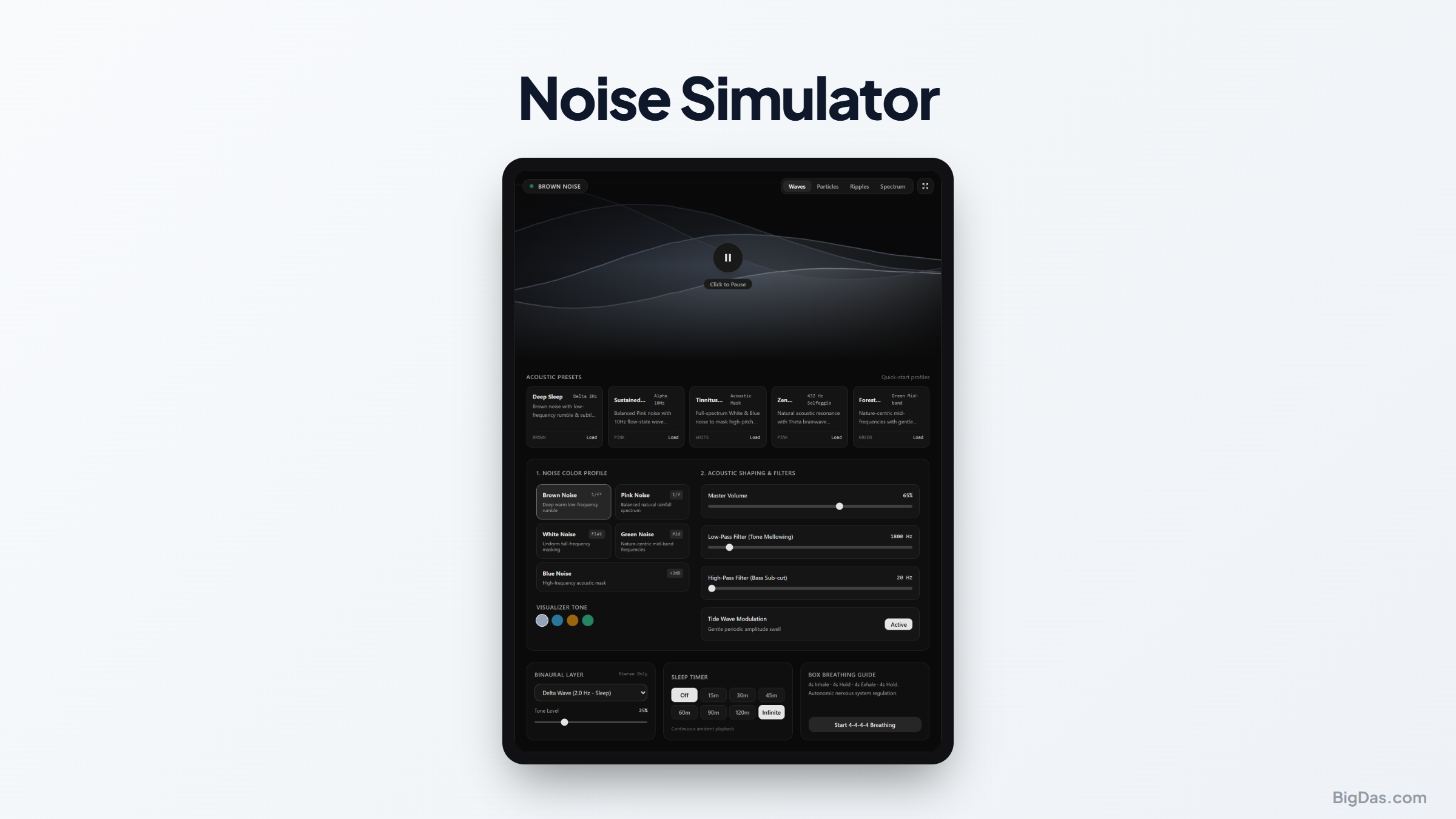
White, Pink and Brown Noise Simulator
 Acoustic spectrum visualization of White, Pink, and Brown Noise with real-time waveform resonance
The Science of Sound: White, Pink, and Brown Noise for Deep Sleep, Tinnitus Relief, and Focus
Ambient noise pollution is one of the most common disruptors of human focus, cognitive performance, and restorative sleep. Sudden acoustic spikes like traffic, office chatter, or sudden indoor sounds trigger an immediate alert response in the nervous system. For millions of others, internal ringing from tinnitus creates a persistent distraction that makes quiet rooms uncomfortable.
The solution is often acoustic masking. By introducing a steady, continuous background sound spectrum, you raise the baseline noise floor so that abrupt sounds no longer startle the brain.
The White, Pink, and Brown Noise Simulator provides an interactive sound generator and visualizer built directly in your browser. Using real-time Web Audio synthesis, the tool generates customizable noise spectrums, binaural beat frequencies, and calming visual landscapes to support sleep, meditation, and productive work sessions.
Understanding Noise Color Spectrums
Sound noise is categorized into colors based on how energy is distributed across the audible frequency range from 20 Hz to 20,000 Hz.
White Noise
White noise contains equal energy across all audible frequencies. Because every frequency has the same intensity, it creates a steady, crisp hiss similar to radio static or rushing air.
Common uses for white noise include:
- Tinnitus Masking: Because tinnitus frequently occurs at higher frequencies between 3 kHz and 8 kHz, the full spectrum energy of white noise blends and softens the ringing sensation.
- Speech Privacy: White noise helps obscure conversations in open offices and study spaces.
- Infant Sleep: The steady sound profile closely mimics the continuous sound environment heard in the womb.
Pink Noise
Pink noise follows a 1/f power distribution, meaning its energy decreases by 3 dB per octave as frequency increases. This creates a balanced, deeper sound that human ears perceive as natural and even. It sounds like gentle rainfall, rustling leaves, or a steady breeze.
Common uses for pink noise include:
- Memory and Deep Sleep: Clinical sleep studies show that pink noise can synchronize with slow-wave brain oscillations during deep sleep, helping to enhance memory retention and sleep quality.
- Sustained Focus: Because pink noise lacks harsh high treble, it is comfortable for long study and work sessions without causing listening fatigue.
Brown Noise
Brown noise, also known as Brownian or red noise, follows a 1/f² power distribution. Its energy drops by 6 dB per octave, concentrating power in the lowest audible bass frequencies. This produces a deep, warm rumble similar to a heavy waterfall, ocean waves, or distant thunder.
Common uses for brown noise include:
- Relaxation and Calming: The prominent low frequencies help encourage physical relaxation and slow breathing.
- Focus for ADHD: Many people find that the deep bass frequencies of brown noise provide enough sensory stimulation to quiet internal racing thoughts and improve focus.
Green and Blue Noise
- Green Noise: Concentrates energy in the middle frequency band between 500 Hz and 2 kHz, replicating the natural acoustic ambiance of a forest canopy.
- Blue Noise: Emphasizes higher frequencies with a 3 dB per octave rise, useful for specialized acoustic masking scenarios.
Binaural Beats and Brainwave Entrainment
The simulator also includes an optional binaural beat layer. When two slightly different frequencies are played into separate ears through stereo headphones, the brain perceives the mathematical difference between them as a rhythmic pulse.
- Delta Waves (0.5 to 4 Hz): Associated with stage 3 and stage 4 deep, restorative physical sleep.
- Theta Waves (4 to 8 Hz): Linked to light sleep, deep meditation, daydreaming, and creative flow.
- Alpha Waves (8 to 13 Hz): Promotes calm alertness, reduced stress, and relaxed focus.
- Beta Waves (13 to 30 Hz): Encourages active concentration and analytical thinking.
- 432 Hz and 528 Hz Resonances: Harmonically pleasing acoustic reference tones traditionally used for relaxation.
How to Use the Simulator
- Select your preferred noise color (Brown for sleep, Pink for work, White for masking).
- Adjust the Low-Pass Filter slider to soften the high frequencies, or the High-Pass Filter slider to trim excess sub-bass rumble.
- Choose an optional visualizer mode such as Waves, Particles, Ripples, or Spectrum.
- Set a sleep timer (such as 30 or 60 minutes) if you are going to sleep. The audio will automatically fade down over the final 30 seconds.
- Use the 4-4-4-4 box breathing guide whenever you need a quick reset for your nervous system.
Frequently Asked Questions
What is the primary difference between White Noise and Brown Noise?
White noise distributes energy equally across all frequencies, resulting in a higher-pitched hiss. Brown noise emphasizes low bass frequencies with a 6 dB per octave rolloff, creating a much deeper, warmer rumble.
Can I leave the sound simulator running overnight?
Yes. The simulator runs locally in your browser with minimal memory and processor usage. You can let it play continuously or set the built-in sleep timer to turn off automatically.
Are headphones required?
Colored noises can be played over room speakers or headphones. If you enable the binaural beats feature, stereo headphones are required so that each ear receives its respective frequency.
How does noise masking help with tinnitus?
Tinnitus occurs when the auditory system amplifies internal noise in quiet environments. Continuous broad-spectrum noise raises the ambient sound level, blending with the ringing frequency so the brain pays less attention to it.