Rainbow / Sun Halo Simulator
 Generated infographic and interface snapshot for Rainbow / Sun Halo Simulator
Simulating Atmospheric Optics: How to Predict and Render Sun Halos and Ice Crystal Phenomena
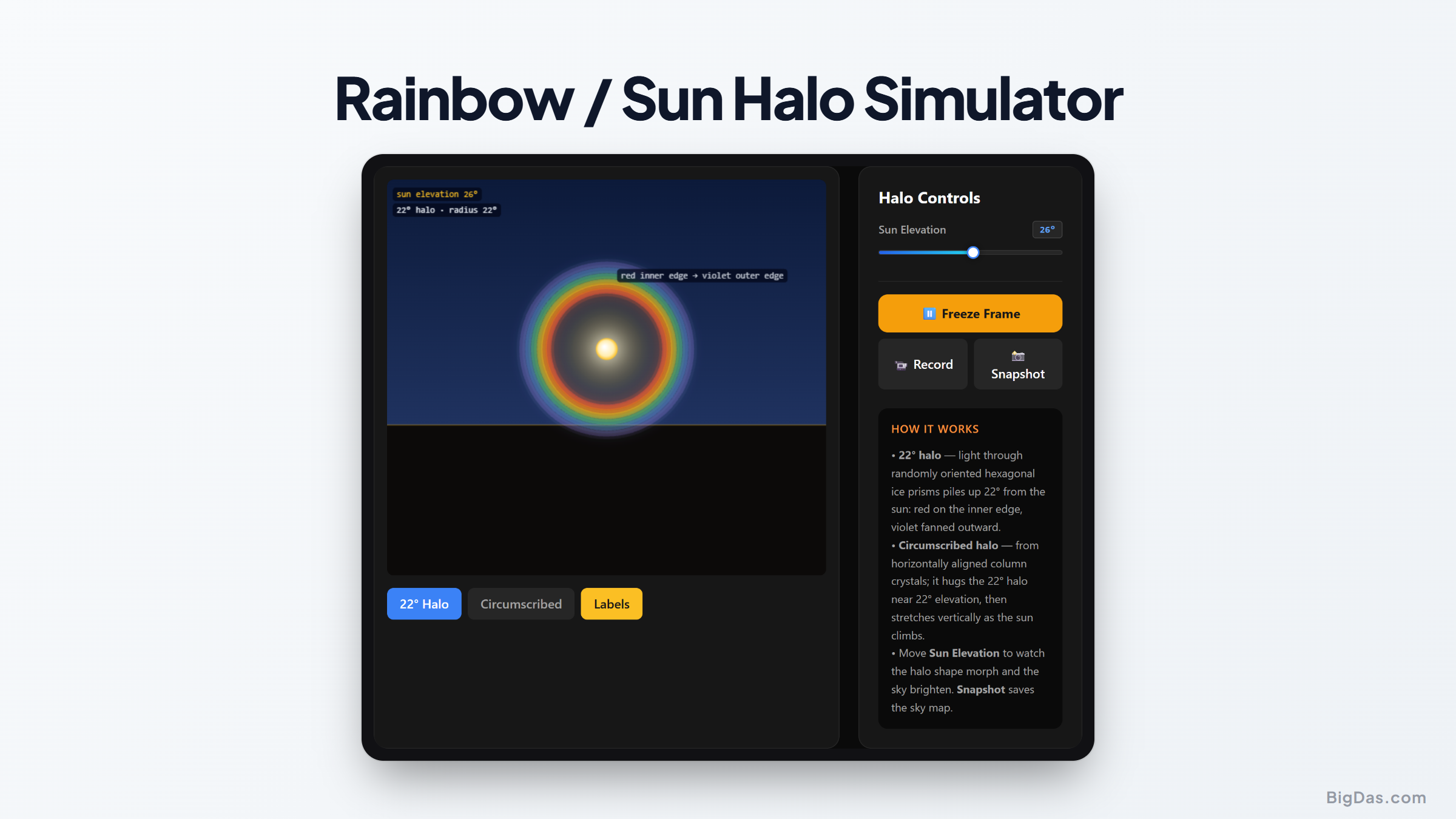
Sun halos are glowing rings, arcs, and spots that appear around the sun on cold, bright days when millions of tiny ice crystals drift high in the atmosphere. They are not rainbows. Light refracts and reflects inside the crystals, producing these displays. For centuries, people treated them as omens. We now have the geometry and physics to model them directly.
This guide covers how the Rainbow and Sun Halo Simulator works, what the controls do, and how to match the on-screen geometry to what you see in the sky.
What is the Rainbow and Sun Halo Simulator?
The Rainbow and Sun Halo Simulator is an interactive tool that models light passing through ice crystals suspended in the atmosphere. It traces thousands of virtual light rays through different crystal shapes and orientations, then renders the resulting arcs, rings, and bright spots on a sky map.
You control the variables that matter in the real atmosphere: crystal shape, crystal orientation, crystal quality, and sun elevation. The output is a geometric projection of what would appear around the sun under those conditions.
Key Features and Benefits of the Simulator
Adjustable Sun Elevation
Sun elevation controls the shape of several halos. The circumscribed halo is the clearest example: at low sun, it forms an oval that loops around the sun. As the sun rises, the loop tightens and eventually merges with the 22° ring near the zenith. The simulator drives this from a single elevation slider, so you can watch the transition in real time.
Diverse Ice Crystal Selection
Ice crystals in cirrus clouds are not uniform. The simulator includes common populations: hexagonal plates, hexagonal columns, and pyramidal crystals. Orientation matters. Random orientation produces circular halos. Horizontally oriented plates produce parhelia (sun dogs), bright spots sitting 22° to either side of the sun.
Accurate Geometric Rendering
The renderer uses the actual refraction and reflection equations, not simplified circles. It produces the 22° halo, circumscribed halos, parhelic circles, infralateral arcs, and supralateral arcs. Rendered geometry matches what observers report under matching conditions.
Light Dispersion Modeling
Ice crystals act as prisms. The simulator models wavelength-dependent refraction, so halos show the red inner border and blue outer edge that appear in real displays. This is useful for identifying which arc you photographed.
Step by Step Guide to Simulating Halos
Step 1: Set the Sun Elevation
Adjust the elevation slider. The value is degrees above the horizon. 10° is early morning or late afternoon. 60° is midday. The grid lines on the sky sphere shift as the value changes, which is a quick way to confirm the angle is set correctly.
Step 2: Select Your Crystal Types
Pick the crystal shapes to place in the virtual cloud. Mix and match if you want. Randomly oriented hexagonal columns or plates give the classic 22° ring. Oriented columns fall through the air with their long axis horizontal, which produces the rarer arcs.
Step 3: Configure Crystal Orientation and Quality
Set how strictly the crystals align. Tight alignment gives sharp, well-defined arcs and bright sun dogs. Loose alignment, with small tilts and imperfections, gives broader, softer halos. Real crystals are imperfect, so loose alignment usually matches real-sky photos better.
Step 4: Analyze the Rendered Geometry
Once the parameters are set, the sky view renders. Pan and zoom to see where each arc sits relative to the sun. Labels mark rare features like the Parry arc or circumzenithal arc, which is useful while you are still learning the catalog.
Primary Use Cases
Outdoor Photography
Rare halos are brief. The simulator lets you work backward from a forecast: if cirrus is moving in and the sun is at 25°, you can check which arcs are geometrically possible and pre-plan your composition.
Teaching
Refraction, reflection, and minimum deviation are easier to teach when students can change a crystal shape and see the arcs change immediately. The simulator covers the standard classroom examples and a long list of rarer phenomena that would be hard to demonstrate otherwise.
Weather Forecasting
Halos indicate cirrostratus, which often precedes a warm front by 12 to 24 hours. Identifying the specific halo type gives a slightly better read on the cloud deck: which crystal habits are present, and roughly how high they sit.
Frequently Asked Questions
What causes a 22 degree halo?
A 22° halo forms when light enters one face of a hexagonal ice crystal and exits through another face that is 60° away from the entry face. The minimum deviation angle for this path is about 22°. With crystals pointing in all directions, the locus of minimum-deviation rays traces a circle 22° from the sun.
How does a circumscribed halo differ from a 22 degree halo?
The 22° halo is always circular because the source crystals are randomly oriented. The circumscribed halo uses horizontally oriented column crystals, and its shape depends on sun elevation. At low sun, it forms an oval tangent to the top and bottom of the 22° ring. As the sun climbs, the oval compresses and finally merges with the 22° ring when the sun is high overhead.
Can you see halos around the moon?
Yes. Lunar halos use the same geometry. They usually look white because moonlight is faint and the eye cannot resolve the dispersion colors. Long-exposure photographs will show the red and blue edges.
What is the difference between a rainbow and a sun halo?
Rainbows come from liquid water droplets. They always sit on the side of the sky opposite the sun. Sun halos come from ice crystals. They always sit around or near the sun.
Summary
The Rainbow and Sun Halo Simulator turns the geometry of ice-crystal optics into something you can adjust and inspect. The physics is the same as in the atmosphere; the simulator just lets you set the parameters. Pick a sun elevation, pick crystal types, set orientation, and the sky map shows you the result.