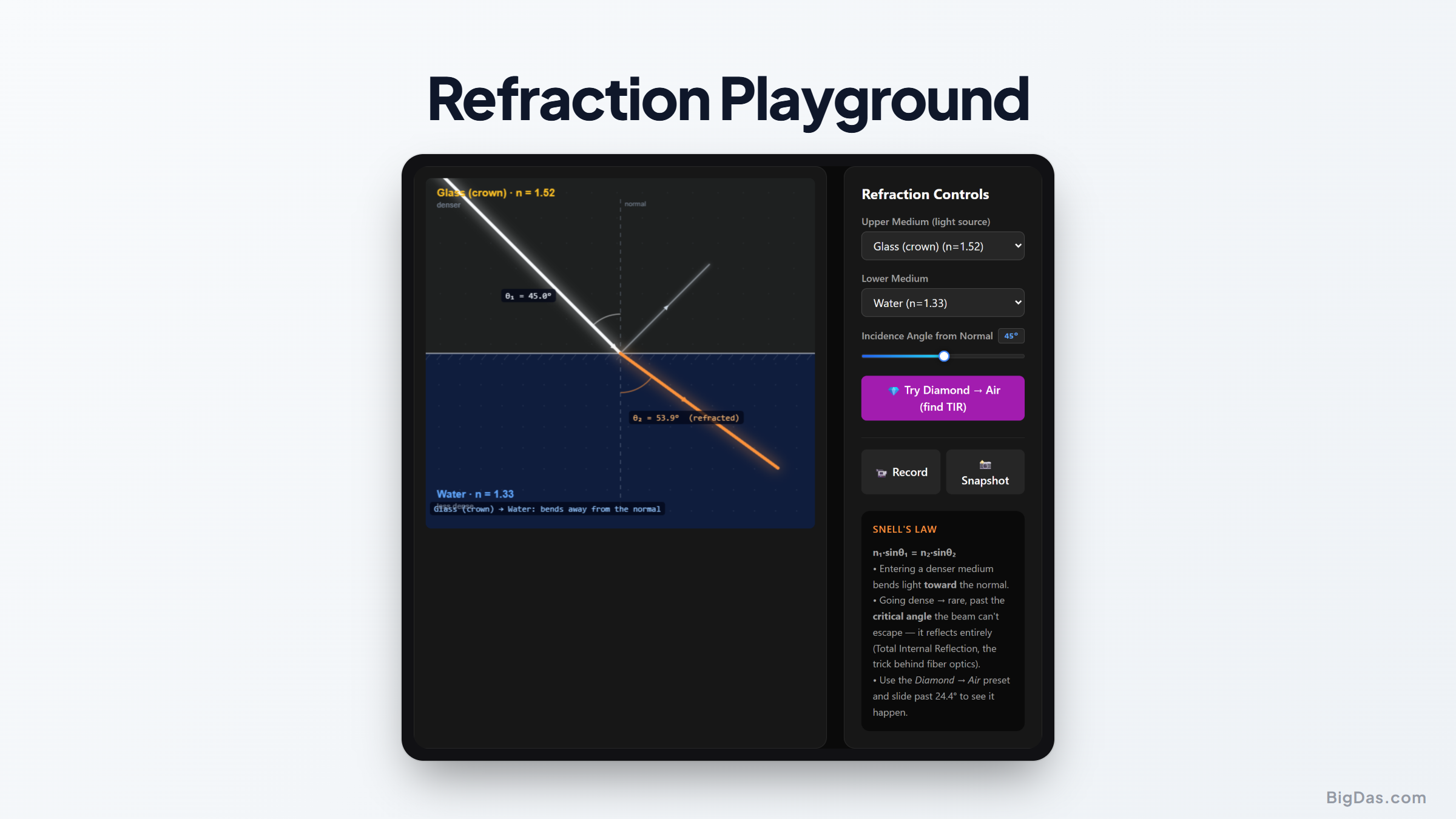
Refraction Playground
 Generated infographic and interface snapshot for Refraction Playground
Visualizing Snell's Law and Total Internal Reflection with Refraction Playground
Light slows down, bends, and sometimes reflects entirely when it moves between different substances. Classroom diagrams and equations cover the math, but they don't always show what the behavior actually looks like.
If you work in telecommunications, optical engineering, or any field that touches lenses and waveguides, you need an intuitive feel for how light behaves at boundaries. Interactive tools make that easier.
Refraction Playground is a web-based simulation that lets you drag a light beam across different materials and watch the refraction and reflection update in real time.
What is Refraction Playground?
Refraction Playground is a web-based interactive physics simulation for experimenting with light behavior. It provides a virtual laboratory where you project a light beam across material boundaries and watch the resulting optics.
The simulator models four materials: air, water, glass, and diamond. Each has its own index of refraction. You drag the light source to change the angle of incidence, and the paths of the transmitted and reflected rays update immediately.
It works for students working through homework, teachers running a classroom demo, and anyone curious about how light behaves at a boundary.
The Physics of Light Bending
Light travels fastest in a vacuum. When it enters water, glass, or diamond, the material's atoms slow the wave down. The index of refraction $n$ describes that slowdown. Water has $n \approx 1.33$, so light travels about 1.33 times slower in water than in a vacuum.
When a light beam hits a boundary at an angle, one side of the wavefront slows down before the other. That speed difference bends the wave, an effect called refraction. Light entering a denser material bends toward the normal line. Light entering a less dense material bends away from the normal line.
Key Features
Dynamic Light Beam Control
The light source is interactive. Click and drag it to change the angle of incidence, and the transmitted and reflected ray paths update instantly. You can see how small angle changes shift the output rays.
Material Selection
The tool includes four materials covering a wide range of optical densities:
- Air: $n \approx 1.00$
- Water: $n \approx 1.33$
- Glass: $n \approx 1.50$
- Diamond: $n \approx 2.42$
Comparing water and diamond side by side makes it obvious how a higher index produces sharper bending.
Visual Representation of Standard Optics Elements
The interface draws the normal line, the incident ray, the refracted ray, and the reflected ray. The labels make it easy to track where the energy goes.
Real-Time Angle Calculations
The simulation displays the angles of incidence, refraction, and reflection numerically, so you can verify Snell's law and the law of reflection against the on-screen geometry.
Step-by-Step Usage
Step 1: Choose Your Materials
The top half of the screen is the first medium (where the light source sits). The bottom half is the second medium. Pick any combination of air, water, glass, or diamond from the interface.
Step 2: Adjust the Light Source
Click and drag the light source to change the angle of incidence. Start at zero degrees (perpendicular to the boundary). At zero degrees, the light passes straight through without bending.
Step 3: Observe the Bending
Tilt the light source to increase the angle. Going from a less dense material (like air) to a denser material (like glass) bends the ray toward the normal. Going the other way bends it away from the normal.
Step 4: Find the Critical Angle
Set the top medium to glass or diamond and the bottom medium to air. Increase the angle of incidence slowly. At some point the refracted ray runs flat along the boundary. That's the critical angle.
Step 5: Observe Total Internal Reflection
Increase the angle past the critical angle. The refracted ray disappears. All the light reflects back into the first medium, behaving like a perfect mirror. This is total internal reflection.
Real-World Applications
Fiber Optic Communication
The internet backbone uses fiber optic cables made from thin glass strands. Light signals stay trapped inside the core by total internal reflection, bouncing along the cable over long distances without escaping.
Diamond Brilliance
Diamonds sparkle because of their high refractive index combined with the angles cut into the stone. Light entering the top undergoes total internal reflection multiple times before exiting back through the top toward the viewer.
Corrective Lenses and Cameras
Eyeglasses, contact lenses, microscope objectives, and camera lenses all rely on refraction. Curved glass bends incoming rays to a focus, correcting vision or forming an image on a sensor.
Frequently Asked Questions
What is refraction?
Refraction is the bending of a light wave when it passes from one medium into another, caused by the change in light's speed between materials.
What is Snell's law?
Snell's law relates the angles of incidence and refraction across a boundary:
$$n_1 \sin(\theta_1) = n_2 \sin(\theta_2)$$
$n_1$ and $n_2$ are the indices of refraction of the two materials, and $\theta_1$ and $\theta_2$ are the angles measured from the normal line.
What is total internal reflection?
Total internal reflection occurs when light traveling in a denser medium hits a boundary with a less dense medium at an angle larger than the critical angle. No light crosses the boundary; all of it reflects back into the denser medium.
What is the critical angle?
The critical angle is the angle of incidence at which the refracted ray runs along the boundary (a refraction angle of 90°). Any larger angle of incidence produces total internal reflection.
Why does light bend when it changes materials?
Light bends because its speed changes between media of different optical density. When a wavefront hits a boundary at an angle, one side of the wavefront changes speed before the other, which rotates the direction of the wavefront.